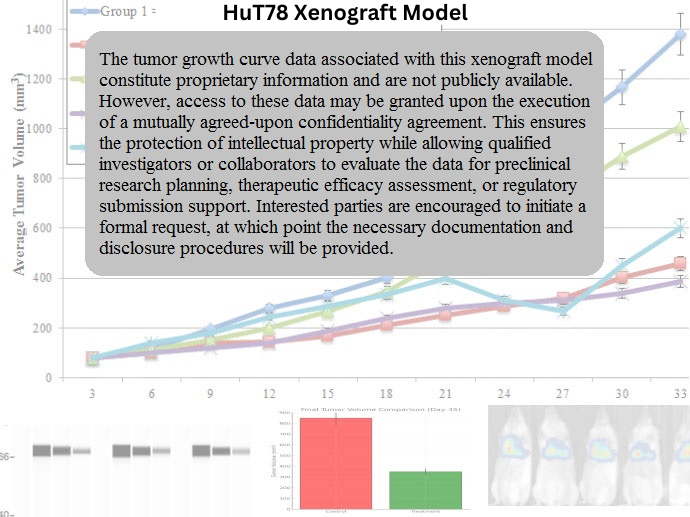
HuT78 Xenograft Model Overview
The HuT78 xenograft model is derived from a human cutaneous T-cell lymphoma (CTCL) cell line originally isolated from a patient with Sézary syndrome, an aggressive leukemic variant of CTCL. As one of the earliest characterized T-cell lymphoma lines, HuT78 has been instrumental in elucidating the molecular pathogenesis of peripheral T-cell malignancies and remains a cornerstone for evaluating therapeutic approaches against T-cell–derived neoplasms. The xenograft model faithfully recapitulates critical aspects of the parental disease, including dysregulated T-cell receptor (TCR) signaling, cytokine dependence, and apoptotic resistance, making it a valuable tool for preclinical drug development in CTCL and related T-cell lymphomas.
Request a Custom Quote for HuT78 Xenograft ModelBiological and Molecular Characteristics
HuT78 cells exhibit a mature post-thymic T-helper phenotype, expressing CD3, CD4, and TCRαβ. The cell line is negative for CD8 and CD25 but positive for CD30, a marker frequently associated with activated T cells and targeted therapeutically in CTCL. These cells carry complex chromosomal abnormalities and demonstrate overexpression of STAT3 and anti-apoptotic proteins such as BCL2 and survivin, which contribute to survival and immune evasion. The cells secrete cytokines including IL-2 and IL-4, and show constitutive activation of the JAK/STAT pathway. This molecular profile aligns with therapeutic targets under investigation in CTCL and other mature T-cell neoplasms.
| Characteristic | Description |
|---|---|
| Tissue Origin | Human cutaneous T-cell lymphoma (Sézary syndrome) |
| Immunophenotype | CD3+, CD4+, CD30+, TCRαβ+, CD8–, CD25– |
| Key Pathways | JAK/STAT activation, BCL2 overexpression, cytokine signaling |
| Cytokine Profile | IL-2, IL-4, TNFα |
| Therapeutic Relevance | STAT3 inhibitors, anti-CD30 therapies, apoptosis modulators |
In Vivo Model Development and Tumorigenicity
The HuT78 xenograft model is established by subcutaneous injection of tumor cells into immunodeficient mice, such as NSG or NOD/SCID. Tumors typically emerge within 2 to 3 weeks post-inoculation and reach measurable volumes between 400–800 mm³ within 6 to 7 weeks. The model exhibits moderate tumor take rates and variable growth kinetics, depending on host strain and tumor microenvironmental conditions. Due to the lymphoid origin and cytokine dependence of the cell line, in vivo supplementation with human cytokines (e.g., IL-2) may enhance engraftment efficiency. The HuT78 model is particularly suitable for studying T-cell lymphoma biology, drug-induced apoptosis, and immunotherapeutic interventions.
Request a Custom Quote for HuT78 Xenograft ModelHistopathology and Immunohistochemical Profile
Histologic evaluation of HuT78 xenografts reveals a diffuse infiltration of medium-sized atypical lymphoid cells with convoluted nuclei, coarse chromatin, and scant cytoplasm. Hematoxylin and eosin staining identifies epidermotropic infiltration patterns when tumors are established orthotopically or in skin-associated models. Immunohistochemical staining shows strong membranous CD3 and CD4 positivity, along with nuclear expression of STAT3 and cytoplasmic BCL2. CD30 is also frequently expressed, supporting the model’s use in studies evaluating CD30-directed therapeutics. Ki-67 proliferation indices are variable but often exceed 60%, depending on tumor stage and cytokine support.
Preclinical Applications and Drug Response
The HuT78 xenograft model is highly applicable to the development of therapies targeting T-cell lymphomas, including CTCL and peripheral T-cell lymphoma (PTCL). It has been utilized in evaluating JAK/STAT pathway inhibitors, HDAC inhibitors, anti-CD30 monoclonal antibodies (e.g., brentuximab vedotin), and apoptosis-inducing agents such as BCL2 antagonists. The model also enables investigation of immune checkpoint inhibitors and cytokine-modulating drugs. Due to its origin from Sézary syndrome, the HuT78 model supports high-fidelity translational studies in advanced CTCL, with applications in drug resistance analysis, immune modulation, and biomarker validation.
Request This Model
To request the HuT78 xenograft model for your preclinical studies, please use the form below. A customized quote and additional model specifications will be provided upon inquiry.
Request a Custom Quote for HuT78 Xenograft Model