Huh-1 Xenograft Model Overview
The Huh-1 xenograft model is derived from a human hepatocellular carcinoma (HCC) cell line established from a male patient diagnosed with primary liver cancer. As a representative model of well-differentiated HCC, Huh-1 supports in vivo studies focused on liver-specific oncogenesis, tumor differentiation, and therapeutic response in hepatocyte-like tumor environments. Compared to more aggressive HCC models, Huh-1 offers slower tumor progression, providing a valuable platform for evaluating long-term treatment effects, cell cycle regulation, and hepatotropic drug specificity. This model is frequently utilized for preclinical drug screening, molecular profiling of HCC subtypes, and mechanistic studies of liver cancer pathophysiology.
Request a Custom Quote for Huh‑1 Xenograft ModelBiological and Molecular Characteristics
Huh-1 cells maintain hepatocyte-like morphology and exhibit expression of liver differentiation markers, including albumin, alpha-fetoprotein (AFP), cytokeratin 18 (CK18), and hepatocyte nuclear factor 4 alpha (HNF4A). They also express E-cadherin, indicating epithelial lineage characteristics. The molecular profile of Huh-1 is consistent with a relatively well-differentiated HCC subtype, with moderate activation of signaling cascades such as Wnt/β-catenin and ERK/MAPK, and limited mesenchymal marker expression. The line is typically TP53 wild-type or harboring non-disruptive mutations, making it suitable for studies that require intact DNA damage response mechanisms or transcriptional regulation of p53-dependent pathways.
| Characteristic | Huh-1 Cell Line Profile |
|---|---|
| Cancer Type | Hepatocellular carcinoma (HCC) |
| Tissue of Origin | Human liver |
| Key Markers | AFP⁺, Albumin⁺, CK18⁺, HNF4A⁺, E-cadherin⁺ |
| Differentiation Status | Well-differentiated |
| Dominant Pathways | Wnt/β-catenin, ERK/MAPK |
| TP53 Status | Wild-type or minimally mutated |
In Vivo Model Development and Tumorigenicity
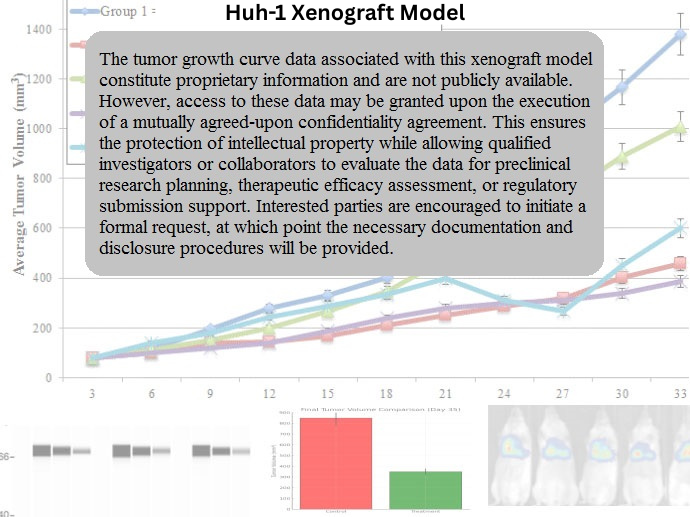
Huh-1 xenografts are typically developed via subcutaneous injection into immunodeficient murine hosts such as nude or NSG mice. Tumor formation is consistent, although growth rates are slower relative to highly aggressive HCC models. Tumors become palpable within 2–3 weeks and progress to volumes of 500–800 mm³ over a 5–7 week timeframe. This controlled growth pattern enables extended treatment windows and time-course pharmacodynamic assessments. Orthotopic liver models can also be established for studies requiring organ-specific interactions, particularly those involving hepatocyte drug metabolism or liver-targeted delivery mechanisms. The model exhibits minimal spontaneous metastasis, aligning it with non-metastatic HCC applications.
Request a Custom Quote for Huh‑1 Xenograft ModelHistopathology and Immunohistochemical Profile
Histological analysis of Huh-1 xenografts reveals uniform, polygonal cells arranged in trabecular or pseudo-glandular structures typical of well-differentiated hepatocellular carcinoma. Tumors show moderate mitotic activity and are composed of eosinophilic cytoplasm-rich cells with low pleomorphism. Immunohistochemical staining confirms strong positivity for albumin, CK18, and AFP, with preserved E-cadherin expression at cell junctions. β-catenin is primarily membranous or cytoplasmic, consistent with limited Wnt pathway activation. CD34 and Ki-67 markers demonstrate modest vascularization and proliferative indices, allowing evaluation of therapeutic impacts on tumor viability and structural integrity.
Preclinical Applications and Drug Response
The Huh-1 xenograft model is widely used to study differentiation therapy, cytostatic agents, and hepatocyte-targeted drugs. Its slower growth kinetics and epithelial phenotype make it ideal for evaluating responses to agents that induce cell cycle arrest or promote differentiation. The model responds variably to multikinase inhibitors, and its sensitivity to DNA-damaging agents and p53-activating compounds has been documented. Huh-1 is particularly relevant in hepatotoxicity screening due to its expression of liver-specific enzymes and transporters. The model also supports mechanistic investigations into hepatocyte development, gene expression regulation, and metabolic pathway alterations in early-stage or low-grade HCC.
Request This Model
To obtain the Huh-1 xenograft model for your hepatocellular carcinoma research or liver-specific drug development studies, contact our scientific team to receive validated model protocols, inoculation techniques, and study design recommendations tailored to well-differentiated HCC investigation.
Request a Custom Quote for Huh‑1 Xenograft Model