HH Xenograft Model Overview
The HH xenograft model is derived from the HH cell line, which originates from a patient with cutaneous T-cell lymphoma (CTCL), specifically Sézary syndrome. This rare and aggressive form of non-Hodgkin lymphoma involves malignant T cells infiltrating the skin, blood, and lymphoid tissues. The HH xenograft serves as a valuable in vivo platform for studying peripheral T-cell lymphomas (PTCLs) of cutaneous origin, with particular relevance for preclinical evaluation of immunotherapeutics, JAK/STAT inhibitors, and HDAC inhibitors. Its unique origin and consistent tumorigenicity in immunocompromised mice provide a disease-representative model system for advancing treatment strategies in T-cell neoplasia.
Request a Custom Quote for HH Xenograft ModelBiological and Molecular Characteristics
HH cells are characterized by a mature T-cell immunophenotype, expressing CD3, CD4, and CD5, while being negative for CD8. The cell line is positive for T-cell receptor (TCR)-β and exhibits markers consistent with a post-thymic memory T-cell origin. Molecular profiling reveals constitutive activation of the JAK/STAT pathway, particularly STAT3 and STAT5, which contribute to survival, proliferation, and immune evasion. HH cells also express high levels of PD-1 and demonstrate aberrant expression of cytokines and chemokine receptors, such as CCR4, making them useful for immunotherapy development. Their epigenetic landscape includes sensitivity to histone deacetylase inhibition, further supporting their application in HDAC inhibitor studies.
| Characteristic | Description |
|---|---|
| Disease Origin | Cutaneous T-cell lymphoma (Sézary syndrome) |
| Immunophenotype | CD3+, CD4+, CD5+, CD8–, TCR-β+ |
| Key Signaling Pathways | JAK/STAT (STAT3, STAT5), immune checkpoint regulation |
| Notable Surface Markers | PD-1+, CCR4+, CD52+ |
| Therapeutic Relevance | JAK inhibitors, HDAC inhibitors, immunotherapies |
In Vivo Model Development and Tumorigenicity
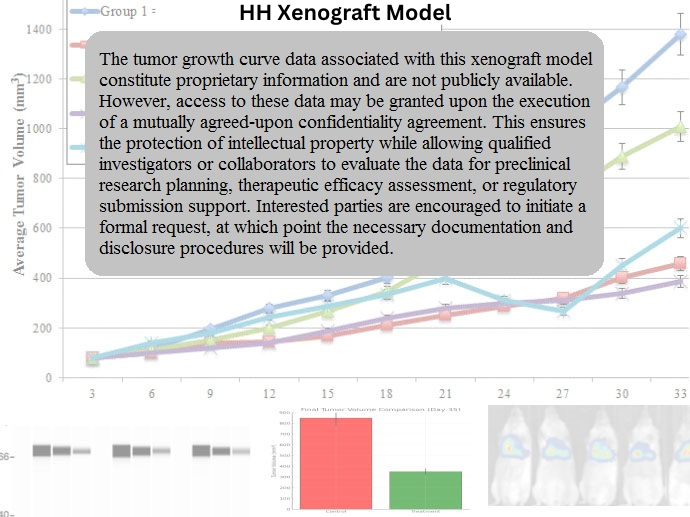
The HH xenograft model is generated via subcutaneous inoculation of HH cells into immunodeficient mice, such as NSG or NOD/SCID strains. Tumor initiation is typically observed within two to four weeks, with measurable growth reaching volumes of 600–800 mm³ by six to eight weeks post-injection. Tumor take rates are high, and the growth pattern is consistent, enabling robust comparative efficacy studies. Due to the model’s capacity to reflect the immunosuppressive microenvironment of T-cell lymphomas, it is frequently employed in studies involving immune modulators, checkpoint blockade, and cytokine-targeted therapies.
Request a Custom Quote for HH Xenograft ModelHistopathology and Immunohistochemical Profile
HH xenografts recapitulate the morphology of cutaneous T-cell lymphoma, consisting of medium-to-large pleomorphic lymphocytes with irregular nuclear contours and scattered mitoses. Histologic sections demonstrate diffuse dermal and subcutaneous infiltration, similar to lesions seen in CTCL patients. Immunohistochemical staining reveals strong CD3 and CD4 expression, with associated nuclear STAT3 positivity and variable PD-1 expression. A moderately high Ki-67 index (~60%) indicates active proliferation. These features substantiate the use of the HH xenograft as a translationally faithful model of Sézary syndrome and related PTCLs.
Preclinical Applications and Drug Response
The HH xenograft model is widely used to investigate therapeutic agents for T-cell lymphomas, particularly those targeting JAK/STAT signaling, immune checkpoints (PD-1/PD-L1), and epigenetic regulators. It has demonstrated utility in studies of romidepsin and vorinostat (HDAC inhibitors), as well as in the evaluation of anti-CCR4 monoclonal antibodies and small molecule JAK inhibitors. Due to its expression of immune-regulatory markers and chemokine receptors, it is also leveraged in studies exploring tumor-immune interactions, tumor trafficking, and microenvironment modulation. The model supports both monotherapy and combination regimens, offering translational insight into therapeutic strategies for CTCL and PTCL.
Request This Model
To request the HH xenograft model for your preclinical studies, please use the form below. A customized quote and additional model specifications will be provided upon inquiry.
Request a Custom Quote for HH Xenograft Model