HGC-27 Xenograft Model Overview
The HGC-27 xenograft model is established from a human gastric carcinoma derived from a 56-year-old male patient with undifferentiated carcinoma of the stomach. This cell line is classified as a poorly differentiated carcinoma and aligns with the diffuse-type category of gastric cancer. HGC-27 xenografts are highly tumorigenic and exhibit aggressive in vivo growth, making them an excellent model for studying advanced-stage gastric malignancies with limited differentiation and high metastatic potential. Given their HER2-negative, microsatellite-stable (MSS), and CDH1-deficient status, these xenografts are particularly suited for preclinical evaluations of drugs targeting epithelial–mesenchymal transition (EMT), stemness, and alternative signaling mechanisms in gastric cancer pathogenesis.
Request a Custom Quote for HGC-27 Xenograft ModelBiological and Molecular Characteristics
HGC-27 cells exhibit a polygonal morphology and loss of glandular structure, consistent with poorly differentiated adenocarcinoma. The model is negative for HER2 amplification and does not express hormone or growth factor receptors commonly targeted in intestinal-type gastric cancer. It harbors mutations in TP53 and is wild-type for KRAS and BRAF. The loss of CDH1 function results in absent E-cadherin expression, promoting cellular motility and invasiveness. HGC-27 is classified as microsatellite stable (MSS) and demonstrates upregulation of mesenchymal markers such as vimentin, ZEB1, and N-cadherin. Aberrant activation of the PI3K/AKT and Wnt/β-catenin signaling pathways contributes to tumor survival, proliferation, and resistance to cytotoxic agents.
| Characteristic | HGC-27 Cell Line Profile |
|---|---|
| Tissue of Origin | Gastric undifferentiated carcinoma |
| HER2 Status | Negative |
| TP53/CDH1 Status | Mutated/Deficient |
| KRAS/BRAF Status | Wild-type |
| MSI Status | Microsatellite stable (MSS) |
| EMT Markers | ↑Vimentin, ↑ZEB1, ↓E-cadherin |
In Vivo Model Development and Tumorigenicity
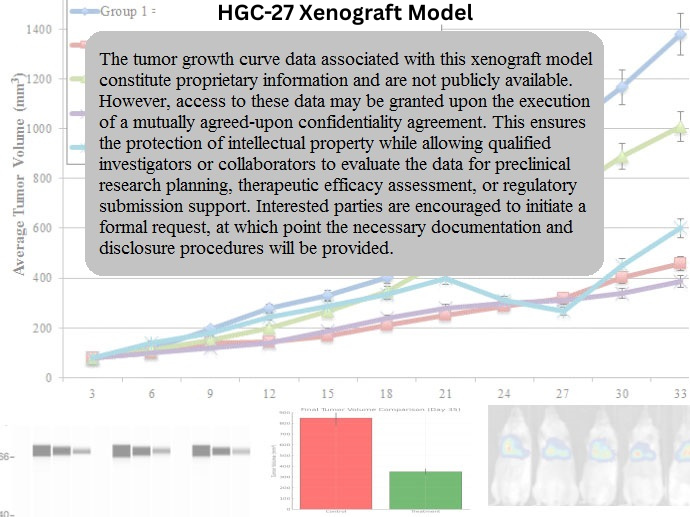
HGC-27 xenografts are generated by subcutaneous injection of tumor cells into immunodeficient mouse strains such as NOD/SCID or athymic nude mice. The tumors form rapidly, with palpable masses developing within 7–10 days and reaching volumes of 700–900 mm³ in approximately 3–4 weeks. The model demonstrates high take rates and aggressive tumor expansion, offering a robust platform for evaluating cytotoxicity, metastatic behavior, and signaling blockade. Due to its undifferentiated histological features and EMT-driven phenotype, the HGC-27 xenograft is well suited for investigating novel drug candidates that target the tumor microenvironment, adhesion molecules, and resistance pathways relevant to diffuse-type gastric cancer.
Request a Custom Quote for HGC-27 Xenograft ModelHistopathology and Immunohistochemical Profile
Histological examination of HGC-27 xenografts reveals undifferentiated tumor architecture with poorly cohesive cells, frequent mitotic figures, and scattered necrotic regions. Hematoxylin and eosin (H&E) staining confirms the absence of glandular formation, characteristic of diffuse gastric carcinoma. Immunohistochemical analysis demonstrates low to absent E-cadherin staining due to CDH1 loss, increased vimentin and ZEB1 expression, and strong nuclear staining for mutant p53. HER2 expression is consistently negative. The absence of structural organization and the expression profile align with EMT and stem-like features, reinforcing the model’s utility in evaluating drug efficacy in poorly differentiated gastric cancer.
Preclinical Applications and Drug Response
The HGC-27 xenograft model is a valuable tool for testing targeted therapies in gastric cancer subtypes lacking actionable mutations such as HER2 amplification or microsatellite instability. It is used extensively to evaluate EMT inhibitors, PI3K/AKT pathway modulators, and Wnt signaling antagonists. The model’s aggressive phenotype and CDH1 deficiency make it suitable for research into peritoneal metastasis, invasion-blocking agents, and resistance mechanisms to traditional chemotherapeutics. Additionally, HGC-27 supports testing of immunomodulatory drugs in immune-compromised settings, particularly those that influence the tumor-stroma interface. Its rapid growth and defined molecular profile provide a reproducible and clinically relevant model for aggressive gastric cancer research.
Request This Model
To request the HGC-27 xenograft model for your gastric cancer research or preclinical drug development projects, contact our scientific team for complete model specifications and personalized study design support tailored to diffuse-type and EMT-positive gastric adenocarcinoma.
Request a Custom Quote for HGC-27 Xenograft Model