HCC44 Xenograft Model Overview
The HCC44 xenograft model is derived from a human non-small cell lung cancer (NSCLC) adenocarcinoma and is widely recognized for its utility in evaluating therapies targeting EGFR-mutant tumors. Originating from a female patient, the parental HCC44 cell line harbors a well-characterized EGFR^L858R mutation, a classical activating alteration that drives constitutive EGFR signaling and promotes tumor proliferation. This model is particularly useful for assessing the efficacy of first-, second-, and third-generation EGFR tyrosine kinase inhibitors (TKIs), as well as combination strategies designed to overcome resistance mechanisms. When implanted into immunodeficient mice, HCC44 cells form moderately fast-growing tumors with epithelial histology, enabling reproducible evaluation of targeted agents and drug resistance profiles in EGFR-driven NSCLC.
Request a Custom Quote for HCC44 Xenograft ModelBiological and Molecular Characteristics
The HCC44 cell line is defined by the presence of the EGFR^L858R point mutation located in exon 21, which induces ligand-independent activation of EGFR tyrosine kinase activity. It is KRAS wild-type and demonstrates intact PTEN signaling, providing a clean background for studying EGFR-specific drug responses without confounding pathway cross-talk. The cell line expresses classical epithelial markers, including cytokeratin 7 and E-cadherin, and demonstrates minimal baseline PD-L1 expression, although expression can be upregulated in response to therapy or inflammatory cues. HCC44 cells exhibit strong dependency on EGFR signaling, making them highly sensitive to EGFR-targeted inhibitors in vitro and in vivo. This molecular profile supports focused exploration of drug resistance pathways, secondary mutation development, and apoptosis restoration strategies.
| Characteristic | Description |
|---|---|
| Tissue Origin | Human lung adenocarcinoma |
| Key Genetic Features | EGFR^L858R mutant, KRAS wild-type, PTEN intact |
| Cell Morphology | Epithelial, adherent |
| Immunomarkers | CK7+, E-cadherin+, PD-L1 low (inducible) |
| Oncogenic Dependency | EGFR signaling, MAPK/PI3K downstream pathways |
In Vivo Model Development and Tumorigenicity
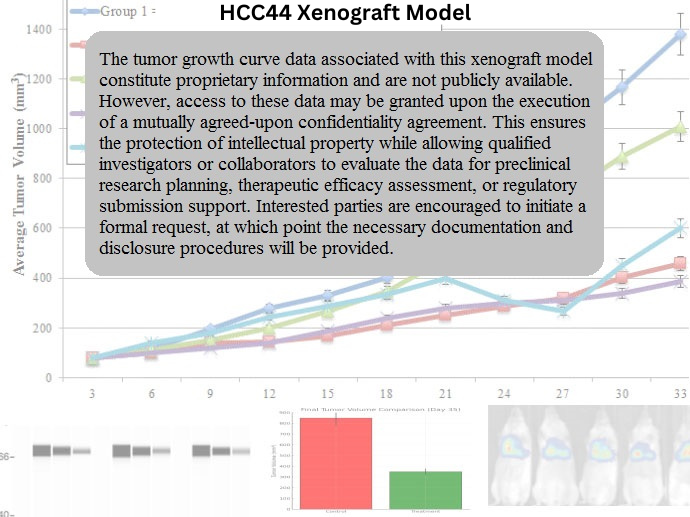
The HCC44 xenograft model is established by subcutaneous implantation into immunocompromised mice, including athymic nude and NOD/SCID strains. Tumors typically appear within 10–14 days and grow at a moderate pace, reaching 300–500 mm³ within 4 to 5 weeks depending on dosing conditions. The model exhibits a high tumor take rate and consistent growth kinetics, making it suitable for controlled efficacy and resistance studies. The reproducible tumor architecture and moderate vascularity facilitate pharmacokinetic evaluations, and the model tolerates repeated dosing schedules necessary for long-term therapeutic assessments. The EGFR mutation status of HCC44 also allows for studies involving sequential inhibitor exposure to simulate clinical treatment progression and resistance development.
Request a Custom Quote for HCC44 Xenograft ModelHistopathology and Immunohistochemical Profile
Tumors generated from HCC44 xenografts display moderately differentiated adenocarcinoma morphology with cohesive epithelial structures, gland-like architecture, and fibrous stroma. Hematoxylin and eosin staining reveals well-formed acini, round nuclei, and scattered mitotic activity. The Ki-67 proliferation index generally falls between 50% and 65%, indicating a steady growth profile conducive to measuring treatment response over time. Immunohistochemical analysis confirms strong cytoplasmic expression of cytokeratin 7 and membranous expression of E-cadherin. EGFR is abundantly expressed on the tumor cell surface, and mutant-specific antibodies detect the L858R variant. PD-L1 staining is focal and low in untreated tumors but increases with therapeutic or immune-modulating intervention, making the model useful for evaluating combination strategies with checkpoint inhibitors.
Preclinical Applications and Drug Response
The HCC44 xenograft model is extensively used in preclinical studies involving EGFR-targeted therapies, including erlotinib, gefitinib, afatinib, and osimertinib. Due to its EGFR^L858R mutation, the model shows high sensitivity to first-generation TKIs, making it ideal for comparative studies of drug potency and resistance evolution. It is also employed to investigate the emergence of secondary resistance mutations, such as EGFR^T790M, under chronic drug pressure. Combination therapies involving EGFR inhibitors and pro-apoptotic agents, such as BCL-2 or MCL-1 antagonists, have demonstrated synergistic efficacy in this system. The model supports investigations into tumor cell plasticity, epithelial-mesenchymal transition, and drug-tolerant persister cell populations. Additionally, it is used to evaluate nanoparticle delivery systems for targeted payloads directed at EGFR or downstream signaling pathways.
Request This Model
To request the HCC44 xenograft model for your preclinical studies, please use the form below. A customized quote and additional model specifications will be provided upon inquiry.
Request a Custom Quote for HCC44 Xenograft Model