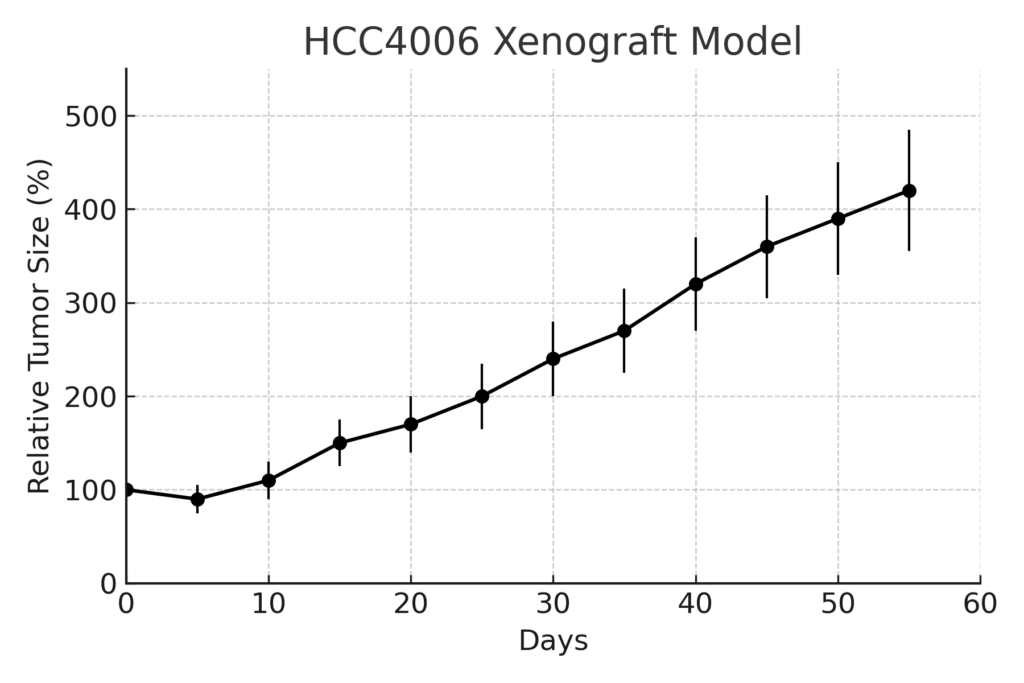
HCC4006 Xenograft Model Overview
The HCC4006 xenograft model is a well-established, EGFR-mutant non-small cell lung cancer (NSCLC) model derived from a female patient with lung adenocarcinoma. Notably, the HCC4006 cell line harbors a deletion in exon 19 of the EGFR gene, rendering it highly sensitive to first- and second-generation EGFR tyrosine kinase inhibitors (TKIs). This model is instrumental in evaluating targeted therapies, drug resistance mechanisms, and combinatorial regimens involving EGFR inhibitors. The HCC4006 xenograft recapitulates key molecular and histopathological features of EGFR-mutant NSCLC and remains a preferred model for translational oncology research involving precision medicine.
Request a Custom Quote for HCC4006 Xenograft ModelBiological and Molecular Characteristics
HCC4006 cells exhibit an epithelial morphology and express high levels of wild-type and mutant EGFR. The defining mutation is a delE746-A750 deletion in exon 19 of the EGFR gene, which confers constitutive activation of downstream signaling pathways, including PI3K/AKT and MAPK. The cell line is wild-type for KRAS, BRAF, and ALK, making it ideal for studying isolated EGFR-dependent signaling. It also expresses epithelial markers such as E-cadherin and cytokeratin 18, and exhibits a low degree of mesenchymal features. The absence of TP53 mutations further supports its utility in controlled therapeutic studies focused on EGFR dependence.
| Characteristic | HCC4006 Cell Line Profile |
|---|---|
| Cancer Type | Lung adenocarcinoma (NSCLC) |
| EGFR Mutation | Exon 19 deletion (delE746-A750) |
| KRAS/ALK/BRAF Status | Wild-type |
| TP53 Status | Wild-type |
| Marker Expression | E-cadherin⁺, Cytokeratin 18⁺, EGFR⁺ |
| Growth Characteristics | EGFR-dependent proliferation |
In Vivo Model Development and Tumorigenicity
The HCC4006 xenograft model is generated through subcutaneous injection into immunodeficient mice, such as NOD/SCID or nude strains. Tumors typically become palpable within 7–10 days post-implantation and reach measurable sizes of approximately 800 mm³ within four to five weeks. The model shows a high tumor take rate and exhibits strong dependency on EGFR signaling for in vivo proliferation. Treatment with EGFR TKIs such as erlotinib or afatinib results in rapid tumor regression, validating the model’s predictive value for clinical response in EGFR-mutant patients. Tumor growth kinetics are highly consistent across cohorts, facilitating reliable therapeutic comparisons.
Request a Custom Quote for HCC4006 Xenograft ModelHistopathology and Immunohistochemical Profile
HCC4006-derived tumors exhibit a well-differentiated adenocarcinoma histology, characterized by glandular structures and basophilic cytoplasm. Immunohistochemistry confirms strong membranous expression of EGFR, with uniform staining across tumor sections. High expression of E-cadherin supports the epithelial nature of the tumor, and the Ki-67 proliferation index typically ranges from 50–70%, indicating a moderate-to-high proliferative capacity. Importantly, EGFR expression remains stable in vivo, and downstream phospho-AKT and phospho-ERK levels are reduced upon treatment with targeted inhibitors, demonstrating a reliable pharmacodynamic biomarker response within this model.
Preclinical Applications and Drug Response
The HCC4006 xenograft model is an essential platform for evaluating first-, second-, and third-generation EGFR inhibitors, as well as dual pathway inhibitors that target EGFR and downstream signaling nodes such as PI3K or MEK. The model is particularly useful in elucidating mechanisms of acquired resistance, including MET amplification, EMT transition, and alterations in apoptotic signaling. Its EGFR dependency makes it an ideal system for combination therapies involving checkpoint blockade, epigenetic modulators, or anti-angiogenic agents. Furthermore, the consistent in vivo behavior of the model supports dose optimization and biomarker-driven clinical translation.
Request This Model
To incorporate the HCC4006 xenograft model into your targeted therapy or biomarker-driven oncology studies, contact us for detailed in vivo performance data, validated EGFR mutation analysis, and customized experimental design support tailored to EGFR-driven tumor research.
Request a Custom Quote for HCC4006 Xenograft Model