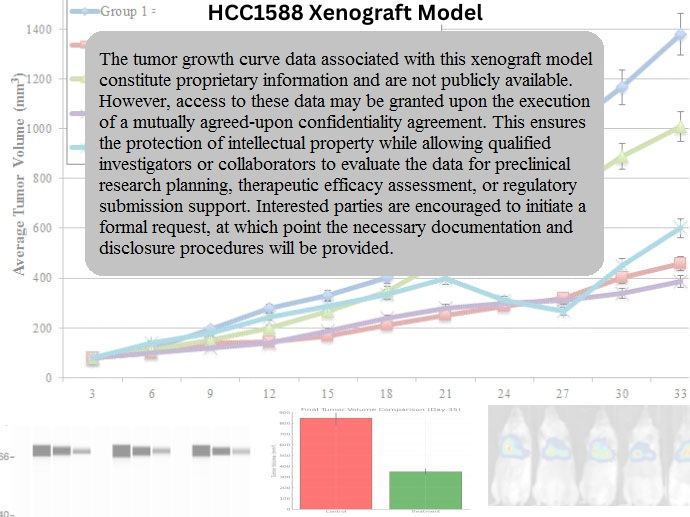
HCC1588 Xenograft Model Overview
The HCC1588 xenograft model is derived from a human non-small cell lung carcinoma (NSCLC) of the adenocarcinoma subtype and represents a valuable system for preclinical investigation of therapeutic strategies targeting EGFR-independent oncogenic pathways. Originating from a male patient, the HCC1588 cell line exhibits epithelial morphology and harbors key mutations associated with treatment resistance, including activating KRAS mutations and inactivated TP53. When established in immunodeficient mice, HCC1588 forms reproducible subcutaneous tumors, making it suitable for evaluating drug efficacy, pharmacokinetics, and resistance mechanisms in a KRAS-mutant lung cancer context. This model supports a wide array of applications in targeted therapy development, particularly for therapeutic agents that bypass EGFR signaling.
Request a Custom Quote for HCC1588 Xenograft ModelBiological and Molecular Characteristics
The HCC1588 cell line is defined by oncogenic KRAS activation and TP53 loss-of-function, both of which drive enhanced proliferative signaling and resistance to apoptotic triggers. These genetic features result in persistent MAPK and PI3K/AKT pathway activation, establishing a molecular profile representative of a treatment-refractory subset of lung adenocarcinoma. The cell line maintains expression of epithelial markers, including cytokeratin 7 and E-cadherin, while showing low to moderate expression of PD-L1, reflecting limited baseline immunogenicity. HCC1588 cells also demonstrate intermediate levels of anti-apoptotic proteins such as BCL-XL, suggesting potential vulnerability to apoptosis-inducing therapies. This molecular composition supports the use of the HCC1588 xenograft model in drug screening studies targeting downstream KRAS signaling and cell death regulators.
| Characteristic | Description |
|---|---|
| Tissue Origin | Human lung adenocarcinoma |
| Key Mutations | KRAS (activating), TP53 (loss-of-function) |
| Cell Morphology | Epithelial, adherent |
| Immunomarkers | CK7+, E-cadherin+, PD-L1 (low to moderate) |
| Oncogenic Pathways | MAPK, PI3K/AKT, apoptosis evasion |
In Vivo Model Development and Tumorigenicity
Subcutaneous implantation of HCC1588 cells into immunodeficient mice, including athymic nude or NOD/SCID strains, results in consistent and reliable tumor formation. Tumors typically emerge within 10–14 days post-inoculation and progress to measurable volumes suitable for therapeutic intervention studies within four to five weeks. The model demonstrates a high take rate and uniform growth patterns, enabling standardized treatment protocols and reproducible endpoint assessments. HCC1588 xenografts are particularly well-suited for evaluating novel therapeutic agents targeting KRAS-associated signaling and for testing synthetic lethality strategies in TP53-deficient tumors. The model also accommodates pharmacodynamic assessments and non-invasive imaging techniques when appropriately labeled.
Request a Custom Quote for HCC1588 Xenograft ModelHistopathology and Immunohistochemical Profile
Histological analysis of HCC1588 xenografts reveals moderately differentiated adenocarcinoma characterized by glandular structures, dense cellularity, and occasional desmoplastic stromal response. Hematoxylin and eosin staining highlights nuclear pleomorphism and a high mitotic index, with frequent abnormal mitoses. Immunohistochemical evaluation shows strong CK7 expression and membranous localization of E-cadherin, confirming epithelial origin. TP53 staining is consistent with mutant p53 accumulation, while Ki-67 proliferation indices exceed 60%, indicating high cellular turnover. PD-L1 staining is typically low and patchy, consistent with a weakly immunogenic phenotype that can be exploited in studies of immune checkpoint activation or adjuvant immunomodulation.
Preclinical Applications and Drug Response
The HCC1588 xenograft model has been employed in numerous preclinical studies aimed at overcoming KRAS-driven therapeutic resistance. It has demonstrated poor responsiveness to EGFR inhibitors, validating its utility in testing alternative pathways such as MEK, ERK, or PI3K inhibition. BCL-2/BCL-XL inhibitors, particularly when used in combination with cytotoxic agents, have shown promise in enhancing antitumor activity. The model is also suitable for evaluating combination regimens involving chemotherapeutics such as pemetrexed and platinum compounds. Its predictable tumor kinetics and moderate immunogenicity support the assessment of nanoparticle-based drug delivery, targeted biologics, and dual-agent regimens incorporating immune checkpoint inhibitors with sensitizing agents.
Request This Model
To request the HCC1588 xenograft model for your preclinical studies, please use the form below. A customized quote and additional model specifications will be provided upon inquiry.
Request a Custom Quote for HCC1588 Xenograft Model