Farage Xenograft Model Overview
The Farage xenograft model originates from a human diffuse large B-cell lymphoma (DLBCL) cell line classified within the activated B-cell–like (ABC) subtype, a clinically significant form of DLBCL characterized by constitutive NF-κB signaling and resistance to conventional immunochemotherapy. Derived from a male patient with Epstein-Barr virus (EBV)-negative DLBCL, Farage cells retain phenotypic markers of mature B cells and demonstrate robust tumorigenic potential in vivo. The model closely mirrors the biologic behavior and treatment resistance mechanisms observed in aggressive non-GCB (non–germinal center B-cell) lymphomas, providing a preclinical system suitable for evaluating therapies directed against NF-κB signaling, B-cell receptor (BCR) pathways, and apoptosis regulation.
Request a Custom Quote for Farage Xenograft ModelBiological and Molecular Characteristics
Farage cells express mature B-cell markers including CD19, CD20, and surface immunoglobulin, as well as MHC class I and II molecules. The cell line lacks expression of CD10 and BCL6, while demonstrating strong nuclear expression of MUM1/IRF4, consistent with the ABC-DLBCL subtype. The cells do not harbor EBV DNA and are wild-type for TP53, though they express elevated levels of BCL2 and show persistent activation of the NF-κB pathway through upstream mediators such as CARD11 and MYD88. Farage cells also maintain a functional CD20 surface expression profile, rendering them responsive to anti-CD20 monoclonal antibodies and other B-cell–directed immunotherapeutics.
| Characteristic | Description |
|---|---|
| Tissue Origin | Human diffuse large B-cell lymphoma (ABC subtype) |
| Viral Status | EBV-negative |
| Immunophenotype | CD19+, CD20+, CD10–, BCL6–, MUM1+, sIg+, HLA-DR+ |
| Key Alterations | NF-κB pathway activation, high BCL2 expression |
| Therapeutic Relevance | BTK inhibition, BCL2 antagonism, anti-CD20, NF-κB blockade |
In Vivo Model Development and Tumorigenicity
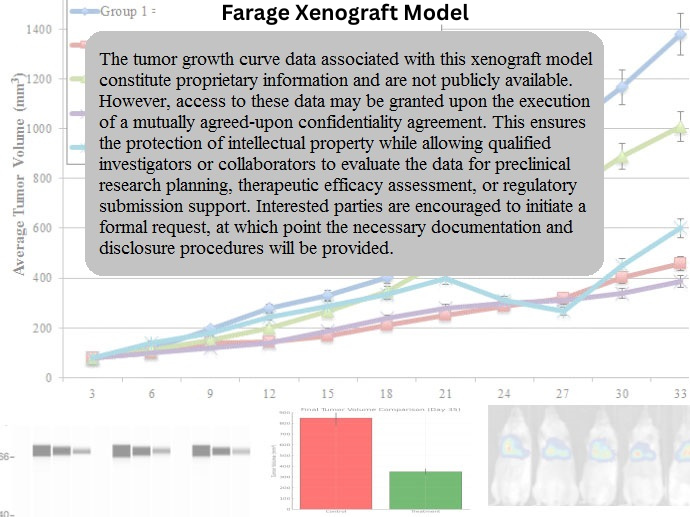
The Farage xenograft model is developed by subcutaneous implantation of cultured cells into immunodeficient mice, typically using NOD/SCID or NSG strains. Tumors form reliably within 2 to 3 weeks and progress rapidly, reaching volumes of 500–800 mm³ within 6 weeks. Farage tumors are moderately vascularized and exhibit consistent take rates and morphology across cohorts. The aggressive growth profile and uniform tumor development enable efficient evaluation of targeted therapies and immunomodulatory strategies in ABC-DLBCL. The model supports drug efficacy studies involving small molecules, monoclonal antibodies, and T-cell–based immunotherapies.
Request a Custom Quote for Farage Xenograft ModelHistopathology and Immunohistochemical Profile
Histologically, Farage xenografts display sheets of large lymphoid cells with vesicular nuclei, prominent nucleoli, and moderate cytoplasm. Hematoxylin and eosin staining reveals a diffuse growth pattern and a high mitotic index, consistent with high-grade lymphoma. Immunohistochemical analysis confirms strong membranous CD20 staining, nuclear MUM1 expression, and cytoplasmic BCL2 positivity. Ki-67 labeling often exceeds 80%, reflecting the aggressive proliferative capacity of the tumor. The absence of CD10 and BCL6 further defines the non-GCB phenotype, while retained expression of MHC class II supports studies involving immune recognition and antigen presentation.
Preclinical Applications and Drug Response
The Farage model is a valuable tool for investigating therapeutic resistance mechanisms in ABC-DLBCL and for evaluating agents that disrupt NF-κB signaling and BCR pathway activation. The model responds to BTK inhibitors such as ibrutinib and BCL2-targeting agents like venetoclax, particularly in combination with anti-CD20 therapies. Farage xenografts also support preclinical assessment of novel immunotherapies, including checkpoint inhibitors, bispecific T-cell engagers, and antibody-drug conjugates. The reproducibility, aggressive growth, and molecular fidelity of this model make it a preferred system for translational research and therapeutic screening in high-risk DLBCL subtypes.
Request This Model
To request the Farage xenograft model for your preclinical studies, please use the form below. A customized quote and additional model specifications will be provided upon inquiry.
Request a Custom Quote for Farage Xenograft Model