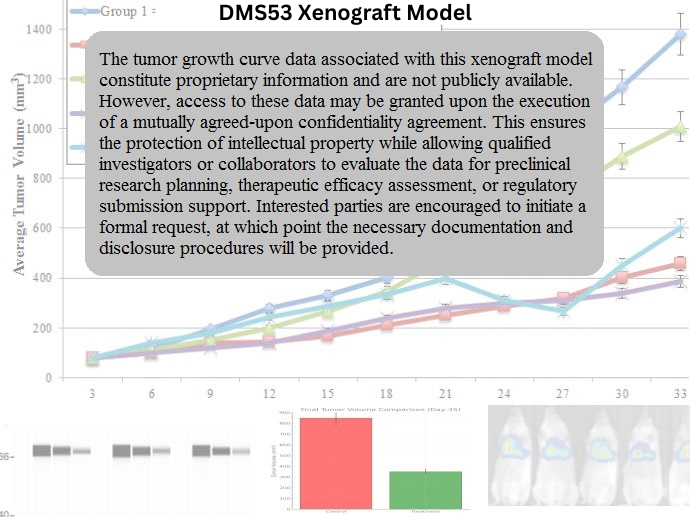
DMS53 Xenograft Model Overview
The DMS53 xenograft model is derived from a human small cell lung carcinoma (SCLC) and is widely used in preclinical oncology for investigating aggressive, neuroendocrine lung cancers. Originating from a male patient, the DMS53 cell line exhibits partial neuroendocrine differentiation and a relatively adherent phenotype, which is uncommon among SCLC lines. When implanted subcutaneously into immunodeficient mice, DMS53 cells generate tumors with moderate growth kinetics, offering a reproducible and tractable model for evaluating targeted therapies, chemotherapeutic agents, and novel drug delivery systems. The DMS53 model is particularly suitable for studies focused on DNA damage response, cell cycle regulation, and epigenetic modulation in SCLC.
Request a Custom Quote for DMS53 Xenograft ModelBiological and Molecular Characteristics
DMS53 cells display a hybrid phenotype, combining features of classical small cell lung carcinoma with partial epithelial characteristics. The cell line expresses neuroendocrine markers such as synaptophysin and neuron-specific enolase (NSE), alongside epithelial proteins including cytokeratin 18 and E-cadherin. Genetically, DMS53 harbors biallelic inactivation of TP53 and RB1, consistent with canonical SCLC biology, but exhibits a more adherent morphology and reduced proliferation rate relative to other SCLC lines. MYC family amplification is absent, while NOTCH signaling remains partially active, indicating a less dedifferentiated neuroendocrine state. PD-L1 expression is typically low, and MHC class I presentation is moderately intact, making DMS53 suitable for immunomodulatory studies and immune-epigenetic combination therapies.
| Characteristic | Description |
|---|---|
| Tissue Origin | Human small cell lung carcinoma |
| Key Alterations | TP53 and RB1 inactivation |
| Phenotype | Neuroendocrine-adherent hybrid |
| Neuroendocrine Markers | Synaptophysin+, NSE+, Chromogranin A (variable) |
| Immunomarkers | E-cadherin+, CK18+, PD-L1 (low), MHC I (moderate) |
In Vivo Model Development and Tumorigenicity
The DMS53 xenograft model is generated by subcutaneous injection into immunocompromised mice, including athymic nude and NOD/SCID strains. Tumor engraftment occurs with high reliability, although growth rates are moderate compared to classical SCLC models such as NCI-H69 or NCI-H82. Palpable tumors typically appear within two weeks post-injection, with progression to volumes of 300–500 mm³ over a period of five to seven weeks. The model’s slower growth kinetics and consistent tumor architecture support long-duration treatment studies and combination therapy protocols. DMS53 is particularly useful in experiments evaluating DNA-damaging agents, such as topoisomerase inhibitors or PARP inhibitors, and in pharmacologic studies of cell cycle and chromatin-modifying targets.
Request a Custom Quote for DMS53 Xenograft ModelHistopathology and Immunohistochemical Profile
Histological analysis of DMS53 xenografts reveals dense sheets of small to intermediate-sized tumor cells with hyperchromatic nuclei, scant cytoplasm, and minimal nucleoli. Mitotic figures and apoptotic bodies are frequent, although necrosis is typically less prominent than in other high-grade SCLC models. Hematoxylin and eosin staining confirms solid architecture with limited stromal infiltration. Immunohistochemistry demonstrates cytoplasmic positivity for synaptophysin and NSE, moderate nuclear expression of ASCL1, and patchy chromogranin A staining. Epithelial markers such as CK18 and E-cadherin are also detected, supporting the model’s hybrid classification. Ki-67 proliferation index averages around 50–60%, indicating a moderately aggressive tumor phenotype suitable for evaluating both cytostatic and cytotoxic responses.
Preclinical Applications and Drug Response
The DMS53 xenograft model is widely utilized in preclinical investigations targeting SCLC with retained epithelial traits and moderate proliferation. It has demonstrated sensitivity to standard-of-care agents such as cisplatin, etoposide, and topotecan, while also serving as a platform for evaluating investigational agents including PARP inhibitors, aurora kinase inhibitors, and epigenetic modulators (e.g., EZH2, HDAC, or LSD1 inhibitors). Due to partial MHC I expression and low PD-L1 levels, the model supports immunotherapy studies aimed at enhancing antigen presentation or combining immune checkpoint blockade with sensitizing agents. DMS53’s hybrid phenotype also makes it suitable for lineage plasticity studies and for testing therapies that exploit dual neuroendocrine and epithelial features.
Request This Model
To request the DMS53 xenograft model for your preclinical studies, please use the form below. A customized quote and additional model specifications will be provided upon inquiry.
Request a Custom Quote for DMS53 Xenograft Model