Colo678 Xenograft Model Overview
The Colo678 xenograft model is derived from a human colorectal adenocarcinoma cell line that was established from the primary tumor of a 58-year-old male patient. Known for its robust epithelial morphology and high tumorigenic potential, Colo678 is an ideal model for preclinical studies focused on colorectal cancer, particularly in the evaluation of drug efficacy and chemoresistance. The model is characterized by its stable growth and consistent response to a variety of chemotherapeutic agents, making it valuable in both standard-of-care drug testing and the development of new therapeutic strategies. Its high proliferation rate and predictable in vivo growth kinetics make Colo678 suitable for long-term studies investigating the effects of combination therapies, targeted therapies, and new drug candidates in colorectal cancer.
Request a Custom Quote for Colo678 Xenograft ModelBiological and Molecular Characteristics
Colo678 cells exhibit classic epithelial morphology with strong intercellular adhesion and polarized monolayer formation in culture. The cell line is microsatellite stable (MSS) and carries a KRAS G12D mutation, which is associated with resistance to EGFR-targeted therapies, making it a relevant model for investigating KRAS-driven tumorigenesis. TP53 is mutated in this model, contributing to a compromised apoptotic response following DNA damage. The model expresses moderate to high levels of carcinoembryonic antigen (CEA) and cytokeratin 20 (CK20), confirming its colorectal origin. Wnt/β-catenin signaling is active, with β-catenin predominantly localized in the cytoplasm and at the membrane, suggesting intact signaling through this pathway. These characteristics render Colo678 an excellent model for studying KRAS-driven, MSS colorectal cancer and for evaluating treatments targeting the EGFR, MAPK, and Wnt/β-catenin pathways.
| Characteristic | Colo678 Cell Line Profile |
|---|---|
| Tissue of Origin | Colorectal adenocarcinoma (primary) |
| KRAS Status | Mutant (G12D) |
| TP53 Status | Mutated |
| MSI Status | Microsatellite stable (MSS) |
| Differentiation Markers | CK20, CEA, E-cadherin |
| Wnt Signaling | Active, β-catenin cytoplasmic/membranous |
In Vivo Model Development and Tumorigenicity
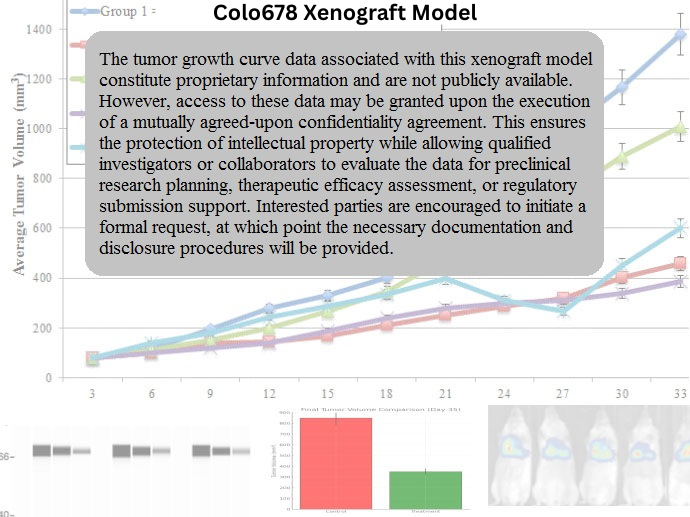
Colo678 xenografts are established by subcutaneous injection of cultured cells into immunodeficient mice, typically athymic nude or NOD/SCID strains. Tumor formation is reliable and occurs within 7 to 10 days after inoculation. Tumor volumes typically reach 700–900 mm³ within 4 to 5 weeks, making it a suitable model for studies requiring long-term evaluation of drug efficacy. Due to its KRAS G12D mutation, Colo678 xenografts are resistant to EGFR inhibitors like cetuximab and panitumumab, providing an opportunity to test novel agents targeting downstream effectors of the MAPK pathway or strategies to overcome KRAS-driven resistance. This model is also applicable for combination therapy studies, as its stable in vivo growth allows for the investigation of potential synergies between chemotherapies and targeted therapies.
Request a Custom Quote for Colo678 Xenograft ModelHistopathology and Immunohistochemical Profile
Histological analysis of Colo678-derived xenografts reveals moderately differentiated adenocarcinomas with glandular structures and areas of central necrosis. The tumors exhibit a well-polarized epithelial structure, with columnar cells and basally located nuclei. Hematoxylin and eosin (H&E) staining highlights moderate mitotic activity, reflecting the model’s rapid proliferation. Immunohistochemical staining shows strong membranous and cytoplasmic β-catenin expression, along with positive staining for epithelial markers such as CK20 and CEA. E-cadherin is expressed along cell–cell junctions, supporting the epithelial phenotype. Mutant p53 is detectable in the tumor nuclei, reflecting its inactivation in this model. The histological consistency and molecular profile of Colo678 xenografts contribute to their use in translational research aimed at understanding drug resistance mechanisms and biomarker identification.
Preclinical Applications and Drug Response
Colo678 xenografts are widely used in studies focused on KRAS-mutant, MSS colorectal cancer, particularly for evaluating agents that bypass EGFR inhibition. The model has been employed in testing novel MAPK pathway inhibitors, including MEK and ERK inhibitors, as well as combination therapies aimed at targeting both RAS-driven pathways and tumor microenvironment signaling. Because of its KRAS mutation and TP53 inactivation, Colo678 is also suitable for evaluating DNA-damaging agents and synthetic lethality strategies. The model is also used in pharmacokinetic and pharmacodynamic studies to assess drug bioavailability, tumor penetration, and biomarker modulation. Additionally, Colo678 xenografts have been valuable in immuno-oncology research, particularly in testing immune checkpoint inhibitors and agents designed to overcome resistance in RAS-mutant tumors.
Request This Model
To incorporate the Colo678 xenograft model into your preclinical research program, contact our scientific team for detailed model specifications and to discuss customized study design options.
Request a Custom Quote for Colo678 Xenograft Model