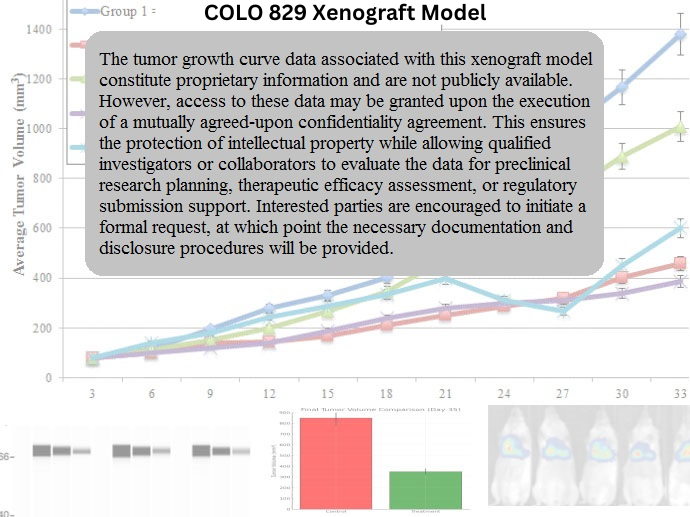
COLO 829 Xenograft Model Overview
The COLO 829 xenograft model originates from the COLO 829 human melanoma cell line, which was derived from a subcutaneous metastasis of a malignant melanoma in a 45-year-old male patient. This model is particularly distinguished by its BRAF V600E mutation and relatively stable genome, making it one of the most extensively characterized melanoma models available. Its well-defined mutational landscape and reproducible in vivo behavior support a broad range of preclinical applications, including targeted therapy, combination regimen development, and studies of drug resistance in BRAF-mutant cutaneous melanoma.
Request a Custom Quote for COLO 829 Xenograft ModelBiological and Molecular Characteristics
COLO 829 cells exhibit features consistent with a malignant melanocytic origin, including strong expression of melanocyte markers such as S100, HMB-45, and Melan-A. The cell line harbors a homozygous BRAF V600E mutation, which drives constitutive activation of the MAPK signaling cascade, promoting uncontrolled proliferation and survival. Notably, COLO 829 has a relatively low mutational burden compared to other melanoma cell lines, which enhances its utility in mechanistic studies by reducing background genomic noise. It also lacks NRAS mutations and shows preserved PTEN expression, making it a valuable model for dissecting MAPK-pathway-driven oncogenesis and response to BRAF-targeted agents.
| Characteristic | Description |
|---|---|
| Tumor Origin | Human metastatic cutaneous melanoma |
| Key Mutation | BRAF V600E |
| Antigen Expression | S100+, HMB-45+, Melan-A+ |
| MAPK Pathway Activity | High, BRAF-driven |
| Mutation Burden | Relatively low for melanoma; suitable for focused pathway studies |
In Vivo Model Development and Tumorigenicity
To establish the COLO 829 xenograft model, cultured tumor cells are injected subcutaneously into immunodeficient mice, typically using NSG or NOD/SCID strains. Tumor initiation occurs within 2–3 weeks, with reproducible expansion and final tumor volumes reaching 800–900 mm³ over a six-week period. Engraftment rates are high, and tumor morphology remains stable across passages. This model’s growth kinetics and mutational stability make it highly suited for pharmacokinetic and pharmacodynamic analyses, particularly in evaluating selective BRAF and MEK inhibitors, as well as for testing resistance-breaking agents.
Request a Custom Quote for COLO 829 Xenograft ModelHistopathology and Immunohistochemical Profile
Histological evaluation of COLO 829 xenografts reveals poorly pigmented tumors composed of epithelioid melanocytic cells arranged in irregular nests and sheets. These cells display vesicular nuclei, prominent nucleoli, and moderate cytoplasmic volume. Immunohistochemistry demonstrates strong cytoplasmic and nuclear expression of S100 and MART-1, along with consistent HMB-45 positivity. The proliferation index, assessed via Ki-67 staining, typically exceeds 60%, aligning with its aggressive growth characteristics. The presence of BRAF V600E protein can be confirmed using mutation-specific IHC, validating the model’s genetic relevance to clinical BRAF-mutant melanoma.
Preclinical Applications and Drug Response
The COLO 829 xenograft model serves as a benchmark system for evaluating BRAF and MEK inhibitors in isolation and in combination with other agents targeting the PI3K/AKT/mTOR pathway. It is widely used in resistance modeling, particularly for secondary mutations that emerge under BRAF inhibitor pressure. Additionally, COLO 829 is utilized in immuno-oncology research involving immune checkpoint blockade and cytokine modulation, despite its use in immunodeficient hosts. The model’s defined genomic profile, BRAF dependency, and consistent in vivo behavior make it a core platform for translational research in melanoma drug development.
Request This Model
To request the COLO 829 xenograft model for your preclinical studies, please use the form below. A customized quote and additional model specifications will be provided upon inquiry.
Request a Custom Quote for COLO 829 Xenograft Model