COLO-320DM Xenograft Model Overview
The COLO-320DM xenograft model is derived from a human colorectal carcinoma cell line established from the ascitic fluid of a 54-year-old male with advanced colon adenocarcinoma. Unlike many colorectal models that exhibit typical gland-forming morphology, COLO-320DM is poorly differentiated and lacks mucin production, making it a unique representative of aggressive, undifferentiated colorectal tumors. The model is widely utilized for studying neuroendocrine features of colorectal carcinoma, drug transporter expression, and amplification-driven drug resistance. COLO-320DM is also notable for harboring double-minute chromosomes, which reflect gene amplification events that are rare among standard colorectal xenografts. This xenograft model is particularly suited for evaluating chemoresistance mechanisms, studying MYC-related oncogenic signaling, and exploring therapeutic responses in tumors with complex genomic architecture.
Request a Custom Quote for COLO-320DM Xenograft ModelBiological and Molecular Characteristics
COLO-320DM cells exhibit a round, non-adherent morphology and possess limited capacity for forming structured epithelial colonies in vitro. The cell line is microsatellite stable and displays chromosomal instability, with high-level amplification of MYC—a defining molecular characteristic. It is also negative for KRAS, NRAS, and BRAF mutations, setting it apart from many conventional CRC models. The presence of extrachromosomal double-minute DNA elements containing amplified MYC oncogene and potentially ABCB1 (MDR1) contributes to multidrug resistance and high proliferative capacity. TP53 is wild-type, which provides an opportunity to evaluate therapies dependent on intact DNA damage response pathways. Expression of neuroendocrine markers such as chromogranin A and synaptophysin has also been reported, supporting its classification as a colorectal line with neuroendocrine differentiation.
| Characteristic | COLO-320DM Cell Line Profile |
|---|---|
| Tissue of Origin | Colorectal adenocarcinoma (ascites) |
| MYC Status | Amplified (double-minute chromosomes) |
| KRAS/NRAS/BRAF Status | Wild-type |
| TP53 Status | Wild-type |
| MSI Status | Microsatellite stable (MSS) |
| Morphology | Non-adherent, round cell type |
In Vivo Model Development and Tumorigenicity
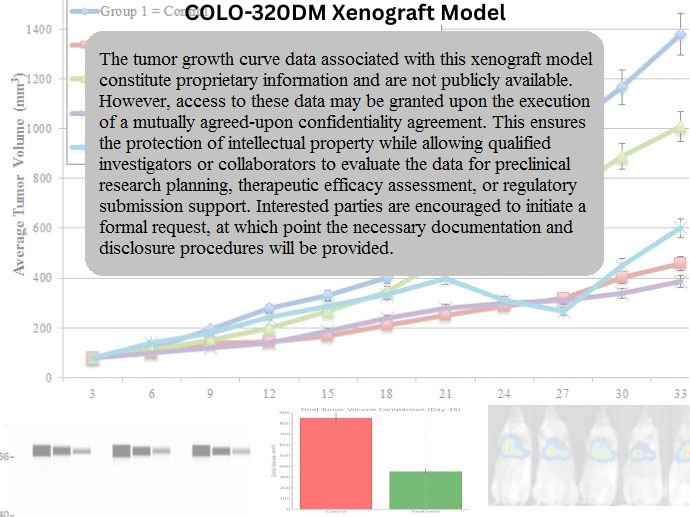
COLO-320DM xenografts are generated by subcutaneous implantation of cells into immunocompromised mice, typically athymic nude or NOD/SCID strains. While initial tumor engraftment may be slower than highly adherent CRC models, once established, tumor growth proceeds with moderate kinetics and demonstrates high reproducibility across cohorts. Tumors typically reach volumes of 700 to 900 mm³ within 4 to 6 weeks. The model is best suited for studies requiring genetically stable, neuroendocrine-influenced tumor behavior or for evaluating resistance mechanisms arising from MYC amplification. It also offers a useful background for testing drug efflux inhibitors and chemotherapeutics whose efficacy is impacted by MDR1 expression. Although it does not display classic glandular architecture or mucin secretion, its unique biological profile compensates with relevance to a less frequently studied CRC subtype.
Request a Custom Quote for COLO-320DM Xenograft ModelHistopathology and Immunohistochemical Profile
Histological analysis of COLO-320DM xenografts reveals poorly differentiated, densely cellular tumors with solid growth patterns and minimal stromal architecture. Glandular formation is absent, consistent with the non-mucinous, neuroendocrine-influenced origin of the line. Immunohistochemical studies frequently demonstrate strong nuclear MYC staining, consistent with gene amplification, and cytoplasmic expression of chromogranin A and synaptophysin in subpopulations of tumor cells. Cytokeratin expression (CK20) is variable, and membranous E-cadherin is weak or absent, reflecting the non-epithelial growth pattern. Expression of MDR1/P-glycoprotein is prominent, correlating with resistance to a broad spectrum of chemotherapeutic agents. These features make COLO-320DM a rare but informative model for mechanistic exploration of MYC-driven CRC and neuroendocrine transition.
Preclinical Applications and Drug Response
The COLO-320DM xenograft model is highly relevant for evaluating therapies targeting MYC-overexpressing tumors, including transcriptional inhibitors, bromodomain inhibitors (e.g., BET inhibitors), and agents that exploit metabolic vulnerabilities conferred by MYC amplification. The model’s robust expression of drug efflux transporters makes it suitable for testing MDR1 inhibitors and for assessing drug bioavailability in resistant tumor types. It is less responsive to DNA-damaging agents such as doxorubicin and cisplatin, but remains sensitive to select targeted agents that do not rely on intracellular accumulation. Due to its neuroendocrine features and non-adherent phenotype, COLO-320DM is also valuable in evaluating the efficacy of anti-proliferative compounds that act independently of epithelial differentiation or adhesion signaling. As a MYC-amplified, TP53-wild-type, KRAS/BRAF-wild-type model, it occupies a distinct space in the spectrum of colorectal xenograft models.
Request This Model
Researchers seeking to investigate drug resistance, MYC-driven oncogenesis, or non-epithelial colorectal tumor behavior will find the COLO-320DM xenograft model a scientifically distinctive and functionally versatile tool. Contact our team to initiate a customized study design using this model.
Request a Custom Quote for COLO-320DM Xenograft Model