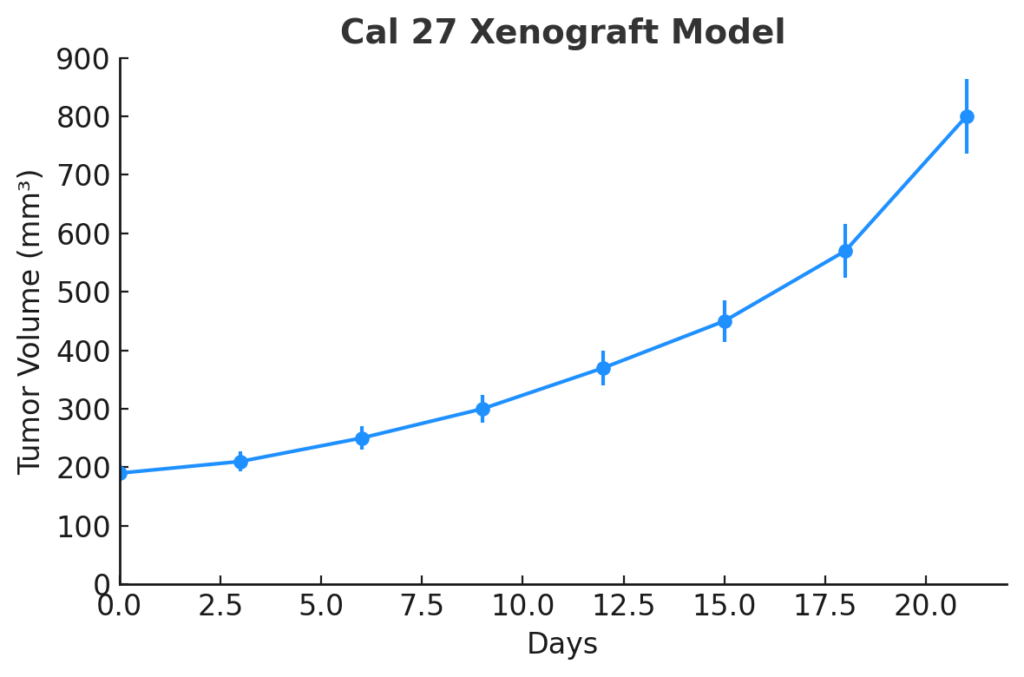
Cal 27 Xenograft Model Overview
The Cal 27 xenograft model is derived from a human tongue squamous cell carcinoma obtained from a 56-year-old male patient with stage IV head and neck squamous cell carcinoma (HNSCC). It is one of the most widely used models for studying oral cavity cancers and provides a clinically relevant platform for evaluating drug efficacy, radiation response, and targeted therapies in aggressive, poorly differentiated head and neck malignancies. Cal 27 xenografts reliably form tumors in immunodeficient mice and recapitulate the histopathological features of advanced HNSCC, including invasive growth, keratinization, and a high mitotic index. The model is instrumental in preclinical research on tumor progression, epithelial–mesenchymal transition (EMT), and resistance to chemoradiotherapy.
Request a Custom Quote for Cal 27 Xenograft ModelBiological and Molecular Characteristics
Cal 27 cells are characterized by their epithelial morphology and origin from moderately to poorly differentiated squamous cell carcinoma. They are TP53-mutated and exhibit overexpression of EGFR, a common hallmark of HNSCC, while lacking human papillomavirus (HPV) infection, placing them within the HPV-negative molecular subtype associated with poor prognosis. The line is also characterized by activation of the MAPK and PI3K/AKT signaling cascades. Notably, Cal 27 cells express cytokeratins such as CK5 and CK14, which are basal epithelial markers, and show variable expression of mesenchymal markers like vimentin under specific stimuli, supporting their use in EMT studies. The absence of functional p16INK4a and dysregulation of cell cycle regulators such as cyclin D1 further contribute to tumorigenicity.
| Characteristic | Cal 27 Cell Line Profile |
|---|---|
| Tissue of Origin | Tongue squamous cell carcinoma (HNSCC) |
| HPV Status | Negative |
| TP53 Status | Mutated |
| EGFR Status | Overexpressed |
| MSI Status | Microsatellite stable (MSS) |
| EMT Potential | Inducible (↑vimentin, ↓E-cadherin under stress) |
In Vivo Model Development and Tumorigenicity
Cal 27 xenografts are typically developed through subcutaneous injection of cultured tumor cells into immunodeficient mice, such as athymic nude or NOD/SCID strains. Tumor formation occurs within 7–10 days post-inoculation, with exponential growth observed until tumor volumes reach 700–900 mm³ within 4–5 weeks. These xenografts exhibit a high engraftment rate and demonstrate consistent growth kinetics, enabling their use in studies requiring uniform tumor establishment across cohorts. Owing to their EGFR-driven oncogenesis and lack of HPV association, Cal 27 tumors are well suited for testing tyrosine kinase inhibitors, radiotherapy combinations, and agents that target DNA damage repair or hypoxic tumor microenvironments typical of head and neck cancers.
Request a Custom Quote for Cal 27 Xenograft ModelHistopathology and Immunohistochemical Profile
Histological analysis of Cal 27 xenografts reveals keratinizing squamous cell carcinoma with solid nests of tumor cells, intercellular bridges, and areas of keratin pearl formation. Hematoxylin and eosin (H&E) staining demonstrates high nuclear pleomorphism, increased mitotic activity, and tumor cell invasion into surrounding stroma. Immunohistochemical staining confirms strong cytoplasmic expression of cytokeratins CK5 and CK14, nuclear accumulation of mutated p53, and intense membranous EGFR expression. The model also shows variable expression of E-cadherin and vimentin, particularly under hypoxic or drug-induced stress, validating its utility for EMT-related therapeutic research in aggressive head and neck carcinoma.
Preclinical Applications and Drug Response
The Cal 27 xenograft model is broadly employed in evaluating novel treatment strategies for head and neck squamous cell carcinomas, particularly in the context of EGFR overexpression and TP53 mutation. It is frequently used for testing EGFR inhibitors (e.g., cetuximab, erlotinib), radiosensitizers, and combinations of cytotoxic agents such as cisplatin and 5-fluorouracil. Its utility extends to preclinical investigations of EMT reversal agents, PI3K/AKT/mTOR inhibitors, and immunomodulatory compounds targeting the tumor microenvironment. The HPV-negative status of Cal 27 makes it especially valuable for modeling therapy-resistant oral cancers and identifying biomarkers predictive of poor clinical outcome.
Request This Model
To access the Cal 27 xenograft model for your head and neck cancer research or drug development studies, please contact our team for detailed specifications and to initiate a customized preclinical study tailored to HPV-negative, EGFR-driven squamous cell carcinoma.
Request a Custom Quote for Cal 27 Xenograft Model