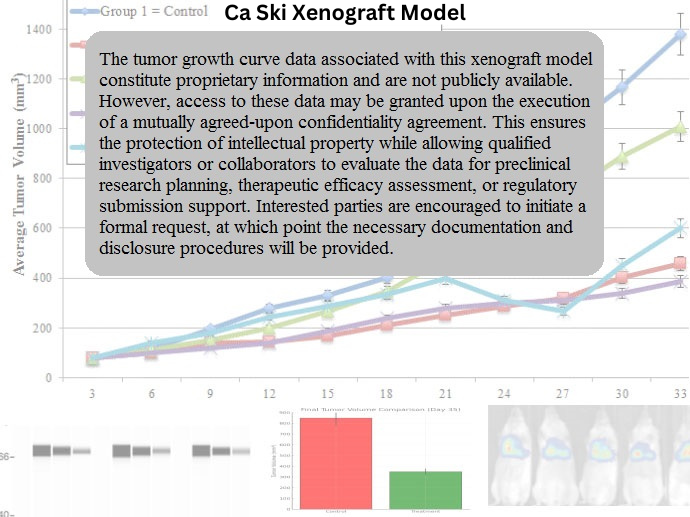
Ca Ski Xenograft Model Overview
The Ca Ski xenograft model is derived from a metastatic epidermoid carcinoma of the cervix and is among the most extensively characterized models of HPV-associated cervical cancer. Originating from a 40-year-old female patient, the Ca Ski cell line contains a high copy number of integrated human papillomavirus type 16 (HPV16) DNA and represents the HPV-driven pathogenesis of advanced cervical squamous cell carcinoma. The model has been widely used to study HPV oncogene function, cervical tumor progression, and the molecular mechanisms underlying immune evasion and therapeutic resistance.
Ca Ski xenografts exhibit high tumorigenicity, consistent HPV E6/E7 expression, and stable epithelial morphology. These characteristics make the model highly suitable for evaluating HPV-targeted therapies, immune checkpoint inhibitors, cytotoxic agents, and pathway-specific small-molecule inhibitors. It serves as a benchmark system for preclinical cervical cancer drug development, especially in studies requiring persistent HPV oncogene expression and viral antigen processing.
Request a Custom Quote for Ca Ski Xenograft ModelBiological and Molecular Characteristics
Ca Ski cells express both E6 and E7 oncoproteins from integrated HPV16 DNA, which functionally inactivate p53 and Rb tumor suppressor pathways. This results in uncontrolled proliferation, genomic instability, and resistance to DNA damage-induced apoptosis. Despite these oncogenic disruptions, the cell line retains epithelial features including E-cadherin expression and high keratin content, reflecting a squamous phenotype. EGFR and PI3K/AKT pathway signaling are moderately active, contributing to cell survival and drug resistance under stress conditions.
| Characteristic | Ca Ski Profile |
|---|---|
| Tumor Type | Cervical squamous cell carcinoma (epidermoid) |
| HPV Status | HPV16-positive (high-copy integration) |
| Oncogene Expression | E6⁺, E7⁺ |
| p53 / Rb Status | Functionally inactivated by E6/E7 |
| EGFR Signaling | Moderate |
| PI3K/AKT Pathway | Activated |
| E-cadherin | Retained |
| EMT Markers | Low |
| Proliferation Index | High (Ki-67 ~65%) |
| Tumor Immunogenicity | High (HPV-derived antigens present) |
These features make Ca Ski a reliable and immunologically relevant model of HPV-mediated cervical cancer biology.
In Vivo Model Development and Tumorigenicity
Ca Ski xenografts are established through subcutaneous injection of 5 × 10⁶ to 1 × 10⁷ cells into immunocompromised mice such as athymic nude or NOD/SCID strains. Tumor take rates exceed 90%, and growth kinetics are rapid, with palpable tumors forming in 7–10 days and reaching terminal volume (~1,200 mm³) within 4–5 weeks.
Tumors display stable growth patterns with minimal spontaneous necrosis, and the model is well-tolerated under standard preclinical conditions. Orthotopic implantation into the cervicovaginal region has also been described and provides enhanced microenvironmental relevance for HPV-driven carcinogenesis, particularly in studies involving mucosal immune surveillance or topical drug administration.
The Ca Ski model is amenable to luciferase tagging, flow cytometry analysis, and immunophenotyping of tumor-infiltrating lymphocytes following immunotherapy regimens.
Request a Custom Quote for Ca Ski Xenograft ModelHistopathology and Immunohistochemical Profile
Histologically, Ca Ski xenografts consist of cohesive sheets of polygonal squamous epithelial cells with intercellular bridges, eosinophilic cytoplasm, and frequent mitoses. Moderate nuclear pleomorphism and occasional keratin pearl formation are observed, consistent with moderately differentiated squamous cell carcinoma.
Immunohistochemical analysis reveals strong staining for cytokeratins (CK5/6, pan-CK), high nuclear Ki-67 expression, and preserved E-cadherin localization. EGFR staining is detectable in a membranous pattern, while phospho-AKT is upregulated in many tumor regions. HPV16 E6 and E7 proteins are consistently expressed and can be visualized with validated antibodies. Nuclear p53 is absent due to proteasomal degradation mediated by HPV E6.
These features confirm the model’s utility for HPV-specific pharmacodynamic monitoring and histologic endpoint validation.
Preclinical Applications and Drug Response
The Ca Ski xenograft model has been extensively applied in preclinical research targeting cervical squamous cell carcinoma, with particular relevance to HPV-dependent oncogenesis. It is a preferred model for:
- HPV vaccine validation (including therapeutic vaccine candidates targeting E6/E7)
- E6/E7 gene silencing studies using siRNA, antisense oligonucleotides, or CRISPR constructs
- Immune checkpoint blockade studies, as the model expresses immunogenic viral antigens
- Radiation sensitization and cisplatin combination therapies, owing to its partial DNA repair dysfunction
- EGFR and PI3K pathway inhibitor screening, to assess oncogenic pathway modulation
- Adoptive T cell therapy and immune effector engagement, especially in humanized mouse models
The Ca Ski model also supports evaluation of local/topical drug delivery systems designed for cervicovaginal tumors, and its high immunogenicity makes it ideal for translational immuno-oncology research.
Request This Model
To integrate the Ca Ski xenograft model into your cervical cancer therapeutic study, HPV-targeted strategy, or immunotherapy development pipeline, request a custom xenograft services package below. Options include HPV antigen quantification, T cell infiltration analysis, combination therapy trials, and immune checkpoint blockade studies.
Request a Custom Quote for Ca Ski Xenograft Model