BEL-7404 Xenograft Model Overview
The BEL-7404 xenograft model is derived from a human hepatocellular carcinoma (HCC) cell line established from a primary liver tumor of a Chinese male patient. This model is widely utilized in preclinical liver cancer studies due to its ability to form aggressive, transplantable tumors in immunodeficient mice. BEL-7404 cells exhibit phenotypic and genetic features consistent with epithelial-derived liver carcinoma, including expression of hepatic markers and oncogenic signaling alterations that reflect common molecular characteristics observed in clinical HCC. The BEL-7404 xenograft system enables evaluation of antitumor agents targeting hepatocellular carcinogenesis, angiogenesis, and liver-specific metabolic pathways.
Request a Custom Quote for BEL‑7404 Xenograft ModelBiological and Molecular Characteristics
BEL-7404 cells display classic epithelial morphology and express key liver cancer–associated proteins, including alpha-fetoprotein (AFP), cytokeratin 18 (CK18), and hepatocyte nuclear factor 4 alpha (HNF4A). These cells exhibit high proliferative capacity and possess alterations in pathways such as Wnt/β-catenin, PI3K/AKT/mTOR, and TGF-β, which are commonly implicated in HCC tumorigenesis. They have also been shown to exhibit partial resistance to apoptosis and altered regulation of genes controlling cell cycle progression. While the full genomic profile of BEL-7404 is still under characterization, the cell line expresses both mesenchymal and epithelial markers, supporting its relevance for studies of epithelial-mesenchymal transition and tumor progression.
| Characteristic | BEL-7404 Cell Line Profile |
|---|---|
| Cancer Type | Hepatocellular carcinoma (HCC) |
| Tissue of Origin | Human liver tumor |
| Key Markers | AFP⁺, CK18⁺, HNF4A⁺, E-cadherin⁺ |
| Signaling Pathways | PI3K/AKT, Wnt/β-catenin, TGF-β |
| Tumorigenicity | High in vivo tumor take rate |
| Applications | HCC drug testing, angiogenesis, EMT, metabolism |
In Vivo Model Development and Tumorigenicity
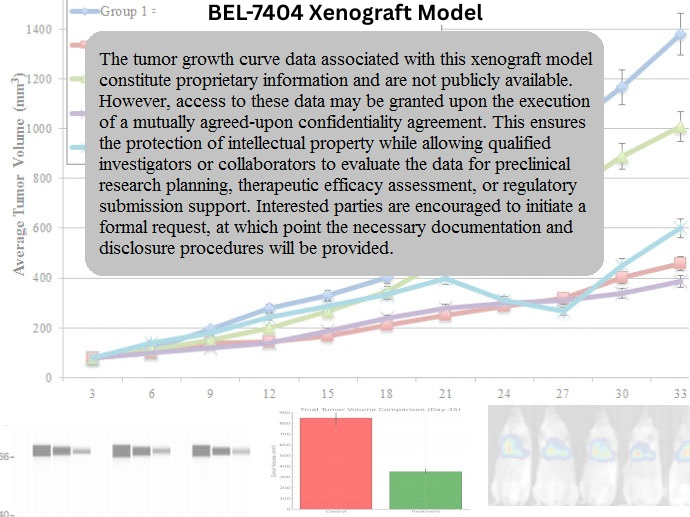
BEL-7404 xenografts are established via subcutaneous injection into immunodeficient mice, such as BALB/c nude or NOD/SCID strains. Tumor take rates are consistently high, with palpable nodules observed within 10–14 days post-inoculation. Tumors exhibit rapid growth kinetics, reaching volumes of 700–900 mm³ within 4–5 weeks, making this model suitable for medium- to short-term efficacy studies. The model is reproducible and well-characterized in terms of tumor morphology, allowing for robust comparative assessment of antitumor agents. Orthotopic liver implantation has also been reported to better recapitulate the tumor microenvironment and liver-specific tumor-host interactions.
Request a Custom Quote for BEL‑7404 Xenograft ModelHistopathology and Immunohistochemical Profile
Histopathological examination of BEL-7404 tumors reveals densely packed sheets of polygonal cells with prominent nucleoli, high nuclear-to-cytoplasmic ratios, and granular eosinophilic cytoplasm. Tumors exhibit moderate vascularization and areas of necrosis in later stages. Immunohistochemical profiling confirms strong positivity for hepatic tumor markers including AFP and CK18. E-cadherin staining is present at cell membranes, while nuclear expression of β-catenin and cytoplasmic staining of phosphorylated AKT and mTOR are commonly observed. Ki-67 staining confirms a high proliferative index, and CD31 staining supports the presence of neovasculature, making the model suitable for evaluating anti-angiogenic therapeutics.
Preclinical Applications and Drug Response
The BEL-7404 xenograft model is employed in preclinical studies targeting hepatocellular carcinoma, with particular relevance for agents directed at the PI3K/AKT/mTOR and Wnt/β-catenin pathways. It is also used in evaluating anti-angiogenic agents, immune checkpoint inhibitors in combination strategies, and liver-targeted drug delivery systems. The model responds to multikinase inhibitors such as sorafenib and lenvatinib, though with variable sensitivity, supporting its role in modeling differential patient response. Due to its metabolic relevance, the model is also valuable in assessing pharmacokinetics and hepatotoxicity of novel compounds in vivo.
Request This Model
To access the BEL-7404 xenograft model for your hepatocellular carcinoma research or therapeutic development program, please contact our scientific team for comprehensive model documentation, validated protocols, and customized study design support tailored to liver cancer drug discovery.
Request a Custom Quote for BEL‑7404 Xenograft Model