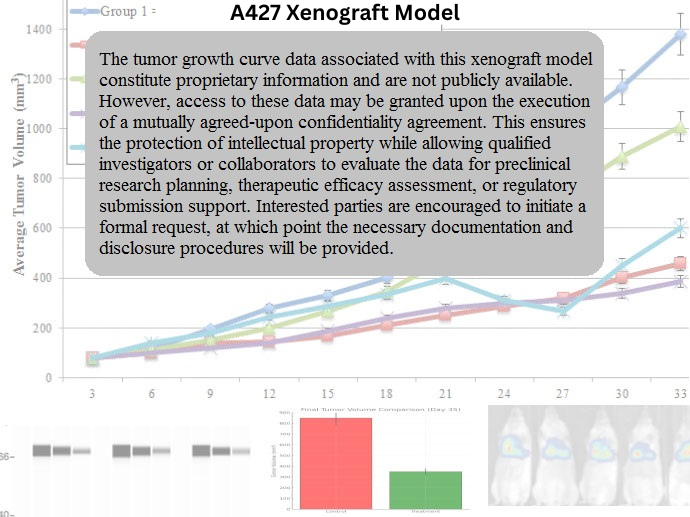
A427 Xenograft Model Overview
The A427 xenograft model is derived from a human non-small cell lung carcinoma (NSCLC) cell line, originally isolated from a lung adenocarcinoma of a 58-year-old male patient. This model represents a KRAS-mutant, EGFR-wild-type subtype of lung cancer, providing a clinically relevant system for preclinical drug development targeting RAS-driven tumorigenesis. A427 cells possess a moderate proliferative rate and epithelial morphology and have been extensively utilized in translational studies focusing on pathway-specific inhibition, resistance mechanisms, and chemotherapeutic evaluation. The A427 xenograft system offers a reproducible and well-characterized in vivo platform for studying non-adenocarcinoma EGFR-independent NSCLC subtypes.
Request a Custom Quote for A427 Xenograft ModelBiological and Molecular Characteristics
A427 cells display epithelial features with adherent growth and a molecular profile defined by a KRAS G12D activating mutation. This mutation leads to sustained activation of downstream RAS-RAF-MEK-ERK and PI3K-AKT signaling pathways. The cell line is wild-type for EGFR and BRAF, and it retains partial p53 activity, making it suitable for assessing the role of intact DNA damage response elements in oncogenic KRAS-driven tumors. A427 cells express epithelial lineage markers such as cytokeratins and E-cadherin while lacking neuroendocrine or squamous cell-specific features. This molecular landscape supports their use in targeted inhibitor testing and biomarker discovery across RAS-centric oncology studies.
| Characteristic | A427 Cell Line Profile |
|---|---|
| Cancer Type | Non-small cell lung carcinoma (adenocarcinoma) |
| KRAS Status | Mutant (G12D) |
| EGFR/BRAF Status | Wild-type |
| p53 Status | Wild-type (functionally active) |
| Marker Expression | Cytokeratin⁺, E-cadherin⁺ |
| Growth Characteristics | Moderate proliferation, adherent monolayer |
In Vivo Model Development and Tumorigenicity
The A427 xenograft model is typically established through subcutaneous injection of cultured cells into immunodeficient mice, including nude or NSG strains. Tumor development is gradual, with engraftment observed within 10–14 days and volumes reaching 600–800 mm³ over 5–6 weeks. Tumors display consistent take rates and uniform growth across cohorts, enabling reliable evaluation of drug efficacy. Due to moderate proliferation, the model is especially useful for long-term dosing studies and investigations of tumor evolution under chronic therapeutic pressure. In addition to the subcutaneous format, the A427 cell line may be adapted for orthotopic models to replicate lung-specific tumor–stroma interactions.
Request a Custom Quote for A427 Xenograft ModelHistopathology and Immunohistochemical Profile
Histological examination of A427 xenografts reveals moderately differentiated adenocarcinoma features. Tumors consist of cohesive epithelial nests and glandular structures, with cells exhibiting eosinophilic cytoplasm, round nuclei, and prominent nucleoli. Immunohistochemistry demonstrates positivity for pan-cytokeratin, CK7, and E-cadherin, confirming epithelial origin. Ki-67 staining reflects moderate proliferative activity, while phospho-ERK and phospho-AKT expression indicates persistent downstream KRAS pathway activation. p53 immunoreactivity is typically preserved, supporting the use of this model in studies involving cell cycle and apoptotic regulation.
Preclinical Applications and Drug Response
The A427 xenograft model is frequently used to assess the efficacy of KRAS-targeted therapies, particularly G12D-specific inhibitors and agents acting on downstream effectors such as MEK or ERK. Its wild-type EGFR status enables investigation of EGFR-independent resistance mechanisms and provides a non-overlapping model to EGFR-mutant systems like PC9 or HCC827. The model is suitable for evaluating combination regimens involving DNA damage response modulators, cell cycle inhibitors, or immune checkpoint blockade in RAS-driven tumor settings. A427 also serves as a comparator in studies aimed at delineating subtype-specific responses among NSCLC xenografts with distinct oncogenic drivers.
Request This Model
To integrate the A427 xenograft model into your RAS-driven NSCLC research pipeline, contact our scientific team for detailed tumor growth data, validated protocols, and comprehensive preclinical support tailored to KRAS-mutant lung cancer investigations.
Request a Custom Quote for A427 Xenograft Model