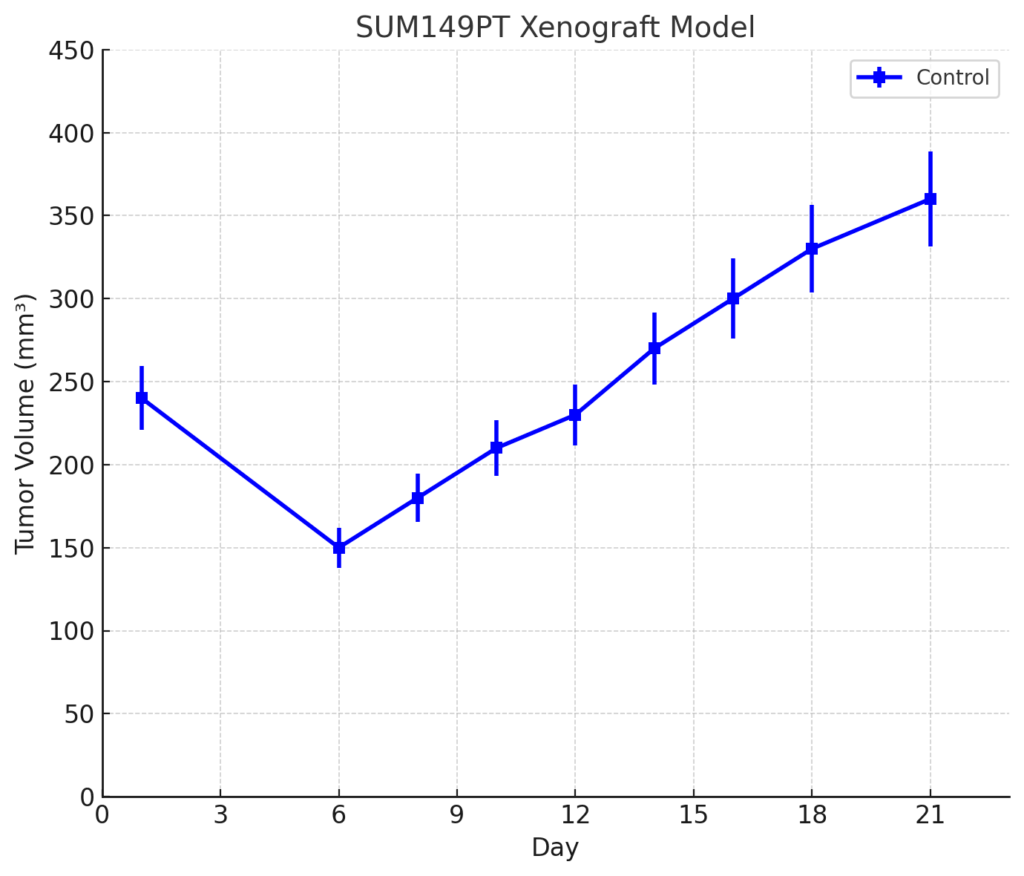
SUM149PT Xenograft Model Overview
The SUM149PT xenograft model is derived from a primary inflammatory ductal carcinoma of the breast, an aggressive and clinically distinct subtype of triple-negative breast cancer (TNBC). Originating from a 47-year-old female patient, the SUM149PT cell line displays basal-like characteristics and is classified as ER-negative, PR-negative, and HER2-negative. This model is widely recognized for its relevance to inflammatory breast cancer (IBC), which accounts for a disproportionate number of breast cancer-related deaths despite its low incidence.
The SUM149PT model exhibits high tumorigenicity, aggressive in vivo growth, and molecular features reflective of both TNBC and IBC phenotypes, including high E-cadherin expression, EGFR positivity, and activation of the JAK/STAT, PI3K/AKT, and NF-κB pathways. It has become an essential tool in preclinical research focused on chemoresistance, tumor emboli formation, immune evasion, and microenvironmental remodeling in inflammatory breast cancer.
Request a Custom Quote for SUM149PT Xenograft ModelBiological and Molecular Characteristics
SUM149PT is a basal-type TNBC cell line that retains some epithelial features, such as E-cadherin expression, despite its high invasive capacity. It is characterized by EGFR overexpression, constitutive NF-κB activation, and robust IL-6 secretion, all of which contribute to a pro-inflammatory and highly invasive tumor phenotype. SUM149PT harbors a BRCA1 wild-type genotype but exhibits homologous recombination deficiency (HRD), making it sensitive to DNA-damaging agents and PARP inhibitors under specific conditions.
This cell line demonstrates a mesenchymal gene expression signature, high levels of reactive oxygen species (ROS), and elevated STAT3 activity. It forms compact clusters of emboli-like structures in vitro and in vivo, mirroring dermal lymphatic invasion seen in clinical IBC.
| Characteristic | SUM149PT Profile |
|---|---|
| Tumor Type | Inflammatory ductal breast carcinoma |
| Receptor Status | ER⁻, PR⁻, HER2⁻ (Triple-negative) |
| Molecular Subtype | Basal-like / Inflammatory breast cancer |
| BRCA1/2 Status | Wild-type (but functionally HR-deficient) |
| EGFR Status | Overexpressed |
| NF-κB / STAT3 Pathways | Constitutively active |
| IL-6 Secretion | High |
| EMT Status | Partial; retains E-cadherin |
| Proliferation Index | High (Ki-67 > 60%) |
| Tumor Emboli Formation | Positive |
These traits make SUM149PT highly relevant for modeling therapy-resistant, inflammatory, and invasive TNBC.
In Vivo Model Development and Tumorigenicity
SUM149PT xenografts are typically generated by subcutaneous or orthotopic injection of 2–5 × 10⁶ cells into immunodeficient mice, such as NOD/SCID or NSG strains. Due to their aggressive growth and high angiogenic potential, tumors become palpable within 7–10 days and rapidly reach volumes exceeding 1,000 mm³ within 3–4 weeks. Tumor take rates approach 100% under optimized implantation conditions.
The model is especially well-suited for orthotopic implantation into the mammary fat pad, which enhances the recapitulation of IBC biology, including skin infiltration, dermal lymphatic obstruction, and compact tumor emboli formation. The aggressive growth kinetics, high vascularization, and inflammation-associated signaling render it ideal for evaluating therapies targeting the tumor microenvironment, angiogenesis, and immune modulation.
SUM149PT tumors may also be labeled with luciferase or fluorescent proteins to facilitate in vivo imaging and non-invasive therapeutic monitoring.
Request a Custom Quote for SUM149PT Xenograft ModelHistopathology and Immunohistochemical Profile
Histologically, SUM149PT xenografts exhibit features characteristic of inflammatory breast cancer, including solid tumor nests, limited glandular differentiation, prominent nuclear pleomorphism, and frequent mitoses. The presence of tumor emboli within dermal lymphatic-like vessels is a distinctive hallmark of this model, reflecting its clinical origin.
Immunohistochemical analysis reveals absent ER, PR, and HER2 expression, strong membranous EGFR positivity, and preserved E-cadherin. Nuclear phospho-STAT3 and cytoplasmic NF-κB p65 are readily detectable, indicating pathway activation. Ki-67 proliferation index often exceeds 60–70%, consistent with rapid tumor progression. Vascular endothelial markers such as CD31 are elevated in tumor-adjacent vasculature, indicating enhanced angiogenesis.
Upon therapeutic intervention, reductions in phospho-STAT3 and IL-6 expression can be quantified as pharmacodynamic biomarkers, while cleaved caspase-3 serves as a marker of apoptosis induction.
Preclinical Applications and Drug Response
The SUM149PT xenograft model is employed extensively in preclinical studies targeting TNBC and IBC-specific mechanisms of progression, invasion, and immune evasion. Its aggressive growth and inflammatory phenotype make it a strong candidate for evaluating:
- PARP inhibitors, particularly in the context of HRD despite BRCA-wildtype status
- EGFR-targeted therapies, including monoclonal antibodies and small-molecule inhibitors
- NF-κB and STAT3 inhibitors, to mitigate pro-inflammatory signaling and immune suppression
- Immunomodulatory therapies, including checkpoint inhibitors and cytokine neutralization
- Anti-angiogenic agents, given the high microvascular density and VEGF expression
Additionally, SUM149PT is useful for studying mechanisms of resistance to conventional chemotherapy agents (e.g., paclitaxel, doxorubicin) and exploring combinations that overcome multidrug resistance and tumor embolization.
This model is uniquely suited for translational research in inflammatory breast cancer—a phenotype not well represented in most other TNBC models.
Request This Model
To incorporate the SUM149PT xenograft model into your inflammatory breast cancer research, TNBC drug discovery, or immuno-oncology platform, request a tailored services package below. Service options include orthotopic implantation, therapeutic dosing regimens, cytokine profiling, and vascular invasion analysis.
Request a Custom Quote for SUM149PT Xenograft Model