MFM-223 Xenograft Model Overview
The MFM-223 xenograft model originates from a pleural effusion of a 61-year-old female patient with metastatic ductal breast carcinoma. It is distinguished by its androgen receptor-positive (AR⁺), estrogen receptor-negative (ER⁻), and progesterone receptor-negative (PR⁻) profile. As such, MFM-223 represents a unique subtype of breast cancer known as molecular apocrine carcinoma, characterized by the expression of AR and luminal cytokeratins despite the absence of ER. This model is particularly valuable for preclinical studies of AR-targeted therapies in breast cancer, a domain of increasing interest as AR-directed agents progress through clinical development.
The MFM-223 model grows moderately in vivo and demonstrates a well-differentiated morphology, making it suitable for long-term treatment studies and biomarker-driven research into androgen signaling, endocrine resistance, and AR crosstalk with oncogenic pathways such as PI3K/AKT and HER2.
Request a Custom Quote for MFM-223 Xenograft ModelBiological and Molecular Characteristics
MFM-223 cells are defined by high androgen receptor expression in the absence of classical estrogen or progesterone signaling. They also exhibit HER2 gene amplification, contributing to downstream activation of PI3K/AKT signaling. These features suggest a therapeutic window for both AR antagonists and HER2-directed agents, as well as combined blockade strategies.
The cell line maintains epithelial characteristics, including E-cadherin positivity and low expression of mesenchymal markers. MFM-223 cells are relatively slow-cycling compared to basal TNBC models and display sensitivity to synthetic and natural androgens in vitro. The unique AR+/ER–/HER2⁺ molecular profile is rare among breast cancer models and corresponds to a distinct clinical subgroup that may benefit from AR-targeted interventions.
| Characteristic | MFM-223 Profile |
|---|---|
| Tumor Type | Human breast ductal carcinoma |
| Receptor Status | AR⁺, ER⁻, PR⁻ |
| HER2 Status | Amplified |
| Molecular Subtype | Molecular apocrine |
| Epithelial Markers | E-cadherin⁺, CK8/18⁺ |
| Mesenchymal Markers | Vimentin⁻ |
| TP53 Status | Mutant |
| PI3K/AKT Pathway | Activated via HER2 amplification |
| Proliferation Rate | Moderate |
| Hormone Responsiveness | Androgen-sensitive; not estrogen-responsive |
These properties support the use of MFM-223 in investigations of non-estrogenic hormone dependence and HER2-AR signaling convergence.
In Vivo Model Development and Tumorigenicity
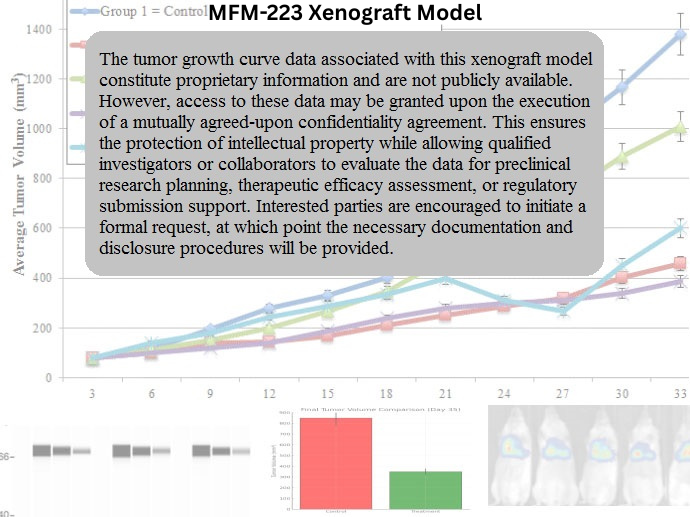
MFM-223 xenografts are established via subcutaneous injection of 5 × 10⁶ cells into immunocompromised mice, typically athymic nude or NOD/SCID strains. Tumor take rates are high (~90%) and do not require hormonal supplementation. Tumors are palpable within 10–14 days and grow to volumes of 1,000–1,200 mm³ over 5–7 weeks, with relatively low necrosis and good vascularization.
Although MFM-223 cells can be orthotopically implanted into the mammary fat pad, their subcutaneous growth profile is sufficient for drug screening and pharmacodynamic studies. Tumor growth is moderately paced, providing a window for multi-week drug regimens, including AR antagonists such as enzalutamide or bicalutamide, HER2 inhibitors like trastuzumab, and combination strategies.
The model is also adaptable for bioluminescent imaging if transduced with luciferase, enabling non-invasive tracking of tumor progression and therapeutic response.
Request a Custom Quote for MFM-223 Xenograft ModelHistopathology and Immunohistochemical Profile
Histologically, MFM-223 xenografts are moderately differentiated tumors that exhibit glandular-like structures, uniform nuclei, and low mitotic indices. The tumors appear cohesive and lack the extensive necrosis typical of more aggressive basal-like models.
Immunohistochemical staining confirms strong nuclear AR expression in nearly all tumor cells. ER and PR staining are absent, while HER2 shows 3+ membranous staining consistent with gene amplification. Ki-67 staining is moderate (30–40%), reflecting the model’s intermediate proliferative capacity. E-cadherin and cytokeratin 8/18 expression support the epithelial identity of the tumor.
Phosphorylated AKT and mTOR are detectable, indicating active downstream signaling from HER2. Caspase-3 and cleaved PARP become evident after therapeutic intervention, supporting this model’s utility in apoptosis-based drug assessment.
Preclinical Applications and Drug Response
The MFM-223 xenograft model is a highly relevant system for evaluating androgen receptor-directed therapies in breast cancer, including selective AR antagonists, degraders, and androgen biosynthesis inhibitors. It has also been used to test the efficacy of HER2-targeted therapies and PI3K pathway inhibitors, either as monotherapies or in rational combinations with AR-directed agents.
Given its moderate growth rate and hormone receptor profile, MFM-223 is ideal for dissecting resistance mechanisms to standard endocrine therapy and studying the role of AR in tumors that lack ER expression. The model supports biomarker development, transcriptomic analysis of AR/HER2 crosstalk, and pharmacokinetic studies with extended treatment timelines.
It has also served in translational studies investigating whether the molecular apocrine subtype should be therapeutically segregated from basal-like TNBC, and whether AR can serve as a driver of tumor growth independent of estrogen signaling.
Request This Model
To integrate the MFM-223 xenograft model into AR-targeted therapy research, HER2 combination trials, or molecular apocrine subtype characterization, request a customized model service package at the link below. Offerings include tumor engraftment, longitudinal treatment response analysis, and biomarker profiling.
Request a Custom Quote for MFM-223 Xenograft Model