DU4475 Xenograft Model Overview
The DU4475 xenograft model is derived from a metastatic breast carcinoma and is classified as a triple-negative breast cancer (TNBC) model with a distinctly rare neuroendocrine-like phenotype. It was originally isolated from a skin metastasis in a 70-year-old female patient with advanced-stage breast cancer. Unlike typical epithelial TNBC models, DU4475 cells are round, non-adherent, and grow in suspension, reflecting an undifferentiated and highly aggressive tumor phenotype. These features make DU4475 a valuable but underutilized tool in investigating circulating tumor cell biology, anchorage-independent survival, and drug resistance mechanisms in TNBC.
The xenograft model reflects the highly metastatic, mesenchymal, and anchorage-independent features of advanced TNBC, and is especially useful for evaluating agents that target survival in the absence of extracellular matrix adhesion, such as anoikis-resistance inhibitors, PI3K/AKT inhibitors, or metabolic modulators.
Request a Custom Quote for DU4475 Xenograft ModelBiological and Molecular Characteristics
DU4475 cells are ER-negative, PR-negative, and HER2-negative, with additional atypical features that distinguish them from classical basal-like TNBC lines. The cells grow as non-adherent spheres in vitro and exhibit poor epithelial marker expression (e.g., E-cadherin), while expressing neuroendocrine-associated markers such as synaptophysin and neuron-specific enolase (NSE). This phenotype suggests differentiation toward a neuroendocrine lineage and makes the model suitable for studying rare subtypes of TNBC.
Genomically, DU4475 cells harbor a BRAF V600E mutation, a unique feature among breast cancer models. They also show loss of PTEN, contributing to persistent PI3K/AKT/mTOR signaling, and a TP53 mutation that supports evasion of cell death pathways. These features make DU4475 a model of interest for exploring BRAF-targeted therapeutics and metabolic vulnerabilities in TNBC.
| Characteristic | DU4475 Profile |
|---|---|
| Tumor Type | Human metastatic breast carcinoma |
| Receptor Status | ER–, PR–, HER2– (TNBC) |
| Growth Characteristics | Suspension, non-adherent, spheroid-forming |
| Neuroendocrine Markers | Synaptophysin+, NSE+ |
| TP53 Status | Mutant |
| BRAF Status | V600E mutation |
| PTEN Status | Deleted |
| PI3K/AKT/mTOR Pathway | Constitutively activated |
| Apoptosis Resistance | High (anoikis-resistant phenotype) |
| EMT Features | Strong (loss of E-cadherin; vimentin+) |
This unique genetic and phenotypic landscape positions DU4475 as a rare model for aggressive, circulating, and neuroendocrine-like TNBC.
In Vivo Model Development and Tumorigenicity
DU4475 xenografts require special handling for in vivo implantation due to the cell line’s suspension nature. Cells are typically injected subcutaneously after mixing with Matrigel to facilitate initial adherence and tumor establishment. The recommended inoculum is 1 × 10⁷ cells per site, with high tumor take rates observed in NOD/SCID or athymic nude mice.
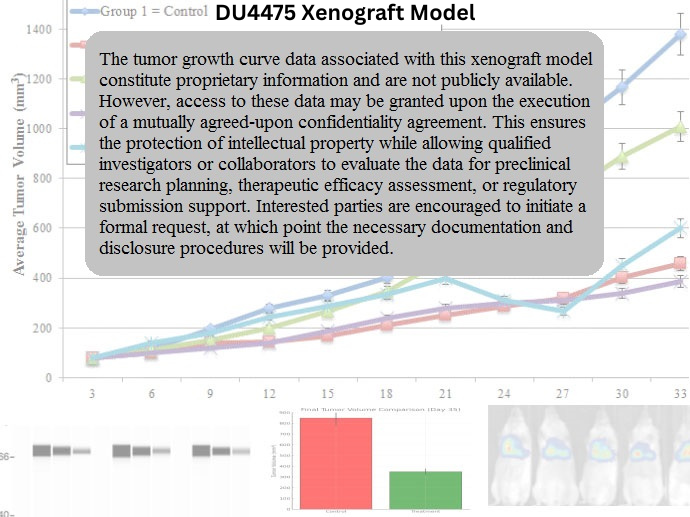
Tumor formation is moderately paced, with nodules forming in 10–14 days and reaching endpoint sizes of 1,000–1,200 mm³ in 5–6 weeks. DU4475 cells demonstrate consistent tumorigenicity without requiring hormonal supplementation. Orthotopic mammary fat pad implantation is less common due to poor adherence but can be adapted with extracellular matrix scaffolds.
In vivo, the tumors maintain their round, poorly cohesive architecture and mirror the spheroid growth observed in vitro. This model is appropriate for evaluating therapies that target matrix-independent growth, anchorage resistance, and cellular plasticity.
Request a Custom Quote for DU4475 Xenograft ModelHistopathology and Immunohistochemical Profile
DU4475 xenografts exhibit poorly differentiated histology, composed of small, round cells with high nuclear-to-cytoplasmic ratios, frequent mitoses, and minimal stromal involvement. Tumors often appear as non-cohesive masses with scant extracellular matrix and regions of necrosis due to rapid cellular turnover and poor vascularization.
Immunohistochemistry shows absent ER, PR, and HER2 staining, consistent with a triple-negative phenotype. E-cadherin is typically negative, while vimentin is strongly expressed, confirming mesenchymal features. Neuroendocrine markers such as synaptophysin and NSE are variably positive. Ki-67 proliferation indices exceed 70%, consistent with rapid growth. Phospho-AKT and phospho-S6 staining is strong, reflecting constitutive pathway activation due to PTEN loss and BRAF mutation.
The histological and immunophenotypic characteristics reinforce the model’s relevance to aggressive, non-epithelial TNBC variants.
Preclinical Applications and Drug Response
The DU4475 xenograft model is particularly valuable in preclinical studies targeting non-epithelial breast cancers and highly aggressive TNBCs. Its sensitivity to PI3K/AKT/mTOR inhibitors, due to PTEN loss, has been documented, and its harboring of the BRAF V600E mutation allows it to serve as a rare model for testing BRAF and MEK inhibitors in breast cancer.
The model is highly resistant to standard chemotherapies such as taxanes and anthracyclines, making it suitable for studying mechanisms of innate drug resistance and strategies to overcome matrix-detached survival. Because of its spheroid-forming behavior and non-adherence, DU4475 is often used to model circulating tumor cells (CTCs) and to test inhibitors of anoikis, epithelial plasticity, and oxidative metabolism.
DU4475 is also appropriate for evaluating combination regimens involving PI3K/BRAF dual inhibition, metabolic modulators (e.g., glutaminase inhibitors), and epigenetic therapies aimed at suppressing neuroendocrine transdifferentiation.
Request This Model
To integrate the DU4475 xenograft model into studies of advanced TNBC, neuroendocrine differentiation, or anchorage-independent growth, use the request link below. Services include Matrigel-assisted tumor engraftment, neuroendocrine marker analysis, and high-throughput therapy response profiling.
Request a Custom Quote for DU4475 Xenograft Model