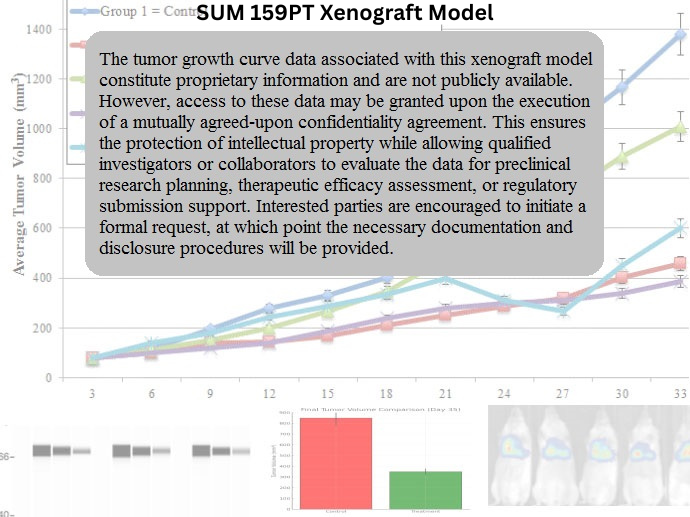
SUM-159PT Xenograft Model Overview
The SUM-159PT xenograft model is derived from a triple-negative breast carcinoma (TNBC) and is considered a benchmark system for studying aggressive basal-like breast cancer with mesenchymal features. Originally established from a chest wall recurrence of a poorly differentiated ductal carcinoma, this model recapitulates the invasive and stem cell-like phenotype seen in advanced-stage TNBC. SUM-159PT cells exhibit high tumor-initiating potential, robust migratory capacity, and a CD44^high/CD24^low surface marker profile, indicative of an enriched cancer stem cell (CSC) population.
The SUM-159PT xenograft is particularly valuable in preclinical oncology due to its rapid growth kinetics, intrinsic chemoresistance, and EMT (epithelial-to-mesenchymal transition)-driven biology. It supports drug development efforts aimed at targeting the mesenchymal and stem-like compartments of TNBC, as well as the tumor microenvironment interactions that facilitate metastasis and therapy escape.
Request a Custom Quote for SUM-159PT Xenograft ModelBiological and Molecular Characteristics
SUM-159PT cells are triple-negative (ER-, PR-, HER2-) and classified within the basal B subtype of TNBC, which is associated with poor prognosis and resistance to conventional chemotherapy. They harbor a homozygous deletion in PTEN, resulting in constitutive activation of the PI3K/AKT signaling axis. The cell line also carries a TP53 mutation and exhibits upregulated expression of mesenchymal markers such as vimentin and N-cadherin, while lacking epithelial markers like E-cadherin.
Notably, SUM-159PT expresses aldehyde dehydrogenase (ALDH1) and displays mammosphere-forming capability, further validating its utility in CSC-targeting drug screens. It also expresses EGFR, albeit at moderate levels, which supports studies involving tyrosine kinase inhibitors.
| Characteristic | SUM-159PT Profile |
|---|---|
| Tumor Type | Human breast carcinoma (TNBC, basal B subtype) |
| Receptor Status | ER–, PR–, HER2– |
| EMT/CSC Features | CD44^high/CD24^low, vimentin+, ALDH1+, E-cadherin– |
| PTEN Status | Homozygous deletion |
| TP53 Status | Mutant |
| PI3K/AKT Pathway | Hyperactivated |
| EGFR Expression | Moderate |
| Mammosphere Formation | Robust |
| Migration/Invasion Potential | High |
| Doubling Time | ~24–30 hours |
These features position SUM-159PT as a high-fidelity model for evaluating EMT-driven metastasis, stem-like plasticity, and PI3K-targeted therapies in TNBC.
In Vivo Model Development and Tumorigenicity
The SUM-159PT xenograft is established by subcutaneous or orthotopic implantation of 3–5 × 10⁶ cells into immunodeficient mice (commonly NOD/SCID or athymic nude). Tumor formation is rapid, with visible nodules appearing within 6–8 days and volumes of 1,200–1,500 mm³ reached within 4–5 weeks. The model shows an extremely high tumor take rate (>95%) and aggressive local expansion.
Orthotopic transplantation into the mammary fat pad is commonly used to preserve tissue-specific interactions and allow evaluation of stromal remodeling, angiogenesis, and tumor-stem cell niche behavior. SUM-159PT xenografts demonstrate high intratumoral heterogeneity and are useful for studies involving clonal dynamics and therapy-induced selection pressures.
Because of their robust growth, these tumors are well suited for longitudinal treatment trials, surgical resection models, and recurrence studies. The model is also adaptable to metastatic spread protocols when injected into the tail vein or intracardiac space, although spontaneous metastasis from primary tumors is rare without additional selection.
Request a Custom Quote for SUM-159PT Xenograft ModelHistopathology and Immunohistochemical Profile
Histologically, SUM-159PT xenografts exhibit a poorly differentiated, invasive morphology with high mitotic index and irregular nuclear features. Tumors typically form dense sheets or nests of cells with spindle-like cytology, accompanied by areas of necrosis, hemorrhage, and a desmoplastic stroma. The absence of glandular differentiation is consistent with its high-grade basal B origin.
Immunohistochemical staining reveals complete loss of ER, PR, and HER2. E-cadherin is undetectable, while vimentin and N-cadherin are diffusely expressed throughout the tumor parenchyma, confirming a strong EMT phenotype. Ki-67 staining is typically high (70–85%), correlating with rapid tumor expansion. ALDH1 and CD44 immunoreactivity are detectable in defined subpopulations, supporting CSC enrichment.
Phosphorylated AKT and mTOR staining confirm active survival signaling, while p53 protein expression is aberrant due to underlying TP53 mutations. The histopathologic profile supports applications in targeting EMT, stemness, and PI3K-driven survival signaling.
Preclinical Applications and Drug Response
SUM-159PT xenografts are ideal for preclinical evaluation of therapies targeting mesenchymal and stem-like TNBC compartments. The model has demonstrated intrinsic resistance to taxanes and anthracyclines, consistent with clinical behavior of basal B TNBC. It is frequently used to test PARP inhibitors, AKT/mTOR inhibitors, CDK4/6 inhibitors, and agents designed to reverse EMT or deplete CSC populations.
Due to its PTEN-null status, SUM-159PT provides a robust system for studying the dependency of TNBC on PI3K/AKT signaling and evaluating the synergistic effects of pathway inhibition with DNA-damaging or anti-mitotic agents. It is also useful in investigating the tumor microenvironment, including cancer-associated fibroblasts and extracellular matrix interactions.
Emerging applications include testing of antibody-drug conjugates (e.g., Trop-2 targeting), small molecule EMT modulators, and epigenetic therapies aimed at reversing stemness and plasticity. The model’s rapid growth and heterogeneity make it a powerful tool for assessing resistance evolution and therapeutic durability.
Request This Model
To incorporate the SUM-159PT xenograft model into triple-negative breast cancer studies focused on stemness, EMT, and PI3K pathway targeting, use the request link below. Services include both subcutaneous and orthotopic engraftment, advanced immunohistochemical analysis, and longitudinal drug efficacy monitoring.
Request a Custom Quote for SUM-159PT Xenograft Model