HCC-70 Xenograft Model Overview
The HCC-70 xenograft model is derived from a primary ductal carcinoma of the breast and represents the basal-like subtype of triple-negative breast cancer (TNBC). Isolated from a 52-year-old African-American female, the HCC-70 cell line is characterized by its lack of expression of estrogen receptor (ER), progesterone receptor (PR), and HER2, placing it squarely in the basal A molecular classification. The xenograft faithfully recapitulates key pathophysiological features of basal-like TNBC, including high proliferation, genomic instability, and aggressive in vivo growth.
HCC-70 xenografts are widely used to investigate TNBC tumor biology, especially in the context of DNA damage response (DDR) deficiencies, checkpoint activation, and targeted synthetic lethality approaches. Their basal marker expression and p53 mutation status make them a suitable system for evaluating drug responses to PARP inhibitors, platinum agents, and cell cycle checkpoint inhibitors in TNBCs with defective homologous recombination.
Request a Custom Quote for HCC-70 Xenograft ModelBiological and Molecular Characteristics
HCC-70 cells are triple-negative and exhibit a gene expression profile typical of basal A breast cancer, including high levels of cytokeratins 5/6 and 14. They harbor a homozygous mutation in the TP53 gene and display pronounced chromosomal instability. Although BRCA1 is not mutated, its expression is often epigenetically reduced, leading to impaired homologous recombination and increased reliance on alternative DNA repair mechanisms. The cells also demonstrate activation of the PI3K/AKT signaling pathway and alterations in cell cycle regulation, particularly involving G2/M checkpoint control.
| Characteristic | HCC-70 Profile |
|---|---|
| Tumor Type | Human breast ductal carcinoma |
| Receptor Status | ER–, PR–, HER2– (TNBC) |
| Molecular Subtype | Basal-like A |
| TP53 Status | Mutant (homozygous) |
| BRCA1 Status | Wild-type, epigenetically suppressed |
| Cytokeratin Expression | CK5+, CK6+, CK14+ |
| PI3K/AKT Pathway | Activated |
| DDR Pathway | Impaired homologous recombination |
| Genomic Stability | Highly unstable |
| Proliferation Rate | High (doubling time <36 hours) |
These molecular characteristics make the HCC-70 xenograft model highly relevant for mechanistic studies of basal TNBC and for testing drugs that exploit DNA repair vulnerabilities.
In Vivo Model Development and Tumorigenicity
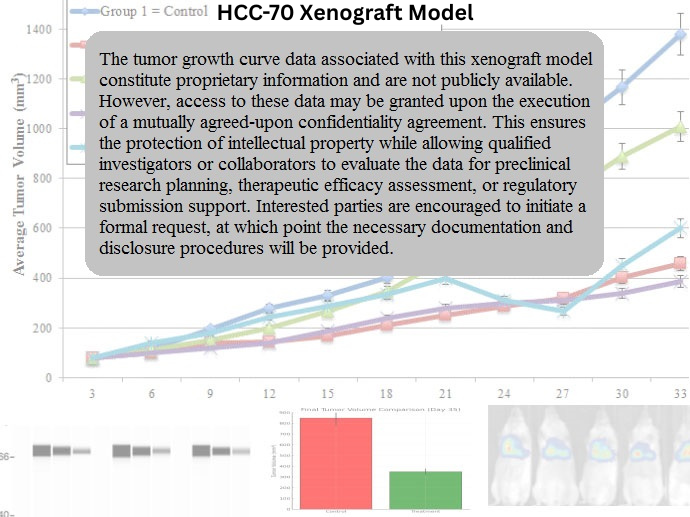
The HCC-70 xenograft is established by injecting 5–10 × 10⁶ cells subcutaneously into immunodeficient mice, typically athymic nude or NOD/SCID strains. Tumor take rates are high, with palpable tumors forming within 7–10 days and reaching volumes of 1,000–1,300 mm³ within 4–5 weeks. Due to the basal-like phenotype and rapid proliferation, this model supports short-cycle efficacy studies and time-sensitive pharmacodynamic evaluations.
Orthotopic implantation into the mammary fat pad is also feasible and can more accurately mimic the tumor’s natural stromal interactions and invasion patterns. The model demonstrates limited spontaneous metastasis, but it can be used in modified systems to assess metastatic potential, especially when paired with hypoxic or stem-like subpopulation enrichment.
Tumors retain their triple-negative and basal marker profiles in vivo, making them suitable for experiments involving biomarker correlation, lineage tracing, and transcriptomic analysis under drug exposure conditions.
Request a Custom Quote for HCC-70 Xenograft ModelHistopathology and Immunohistochemical Profile
HCC-70 xenografts consist of solid sheets of medium-to-large polygonal cells with high nuclear-to-cytoplasmic ratios, prominent nucleoli, and brisk mitotic activity. The tumors are hypercellular and frequently display areas of necrosis, especially in rapidly growing lesions. Histologically, the tumors resemble poorly differentiated invasive ductal carcinomas of basal phenotype.
Immunohistochemical staining confirms absence of ER, PR, and HER2. Basal cytokeratins (CK5/6, CK14) are strongly positive, and Ki-67 indices typically range between 60% and 80%, indicating high proliferative potential. Phosphorylated histone H2AX (γH2AX) and checkpoint proteins such as Chk1/Chk2 are upregulated in response to genotoxic agents, validating the model’s use in DNA damage response studies. PTEN expression is reduced in some sublines, supporting PI3K pathway activation.
The histopathologic and IHC profile supports the use of HCC-70 in exploring therapeutic vulnerabilities in aggressive TNBC subtypes.
Preclinical Applications and Drug Response
The HCC-70 xenograft model is highly suitable for preclinical evaluation of agents targeting DNA repair pathways, particularly PARP inhibitors and ATR/CHK1 inhibitors, given its defective homologous recombination. It responds favorably to platinum-based chemotherapy agents, including cisplatin and carboplatin, which generate DNA crosslinks that are poorly repaired in HR-deficient cells.
In addition, the model is used to study PI3K/AKT/mTOR pathway inhibitors, anti-mitotic agents, and cell cycle checkpoint modulators. It is also relevant in evaluating combinatorial regimens that include immunomodulators or angiogenesis inhibitors, especially in scenarios where genomic instability leads to neoantigen generation.
Given its basal-like classification and rapid in vivo growth, HCC-70 provides a consistent and reproducible platform for screening compounds intended for difficult-to-treat TNBCs and for biomarker-driven drug development.
Request This Model
To incorporate the HCC-70 xenograft model into triple-negative breast cancer drug development pipelines or mechanistic studies of DNA damage repair and checkpoint targeting, please use the custom quote request link below. Comprehensive services are available for subcutaneous or orthotopic tumor establishment, endpoint analysis, and customized therapeutic evaluations.
Request a Custom Quote for HCC-70 Xenograft Model