JIMT-1 Xenograft Model Overview
The JIMT-1 xenograft model is a clinically relevant system derived from a HER2-positive human breast carcinoma and is widely recognized for its intrinsic resistance to trastuzumab (Herceptin). The model was developed from the pleural metastasis of a patient with HER2-overexpressing breast cancer who had previously undergone trastuzumab therapy, making it uniquely suited for studying mechanisms of primary therapeutic resistance. Unlike other HER2-positive breast cancer models, JIMT-1 maintains elevated HER2 expression yet demonstrates poor response to HER2-targeted monoclonal antibodies, owing to molecular alterations in receptor trafficking, glycosylation, and downstream signaling.
JIMT-1 xenografts offer a robust platform for evaluating next-generation HER2-targeted therapeutics, understanding bypass resistance pathways, and testing combination regimens designed to overcome refractory HER2-driven breast tumors. Its aggressive growth kinetics and high take rate in immunodeficient mice make it ideal for pharmacodynamic profiling and therapeutic efficacy studies.
Request a Custom Quote for JIMT-1 Xenograft ModelBiological and Molecular Characteristics
JIMT-1 cells strongly overexpress HER2 (ERBB2 gene amplification), consistent with HER2-enriched breast cancers, but harbor distinct molecular traits that confer trastuzumab resistance. These include high expression of MUC4, a membrane-associated mucin that sterically hinders antibody binding to the HER2 epitope, as well as alterations in receptor internalization and degradation. The model lacks estrogen and progesterone receptor expression, classifying it as HER2-positive/hormone receptor-negative.
PIK3CA mutations and PTEN loss are commonly observed in JIMT-1, contributing to constitutive activation of the PI3K/AKT signaling pathway, which promotes proliferation and survival independently of HER2 blockade. Additional features include overexpression of anti-apoptotic proteins and reduced HER2 ubiquitination, both of which enhance treatment resistance.
| Characteristic | JIMT-1 Profile |
|---|---|
| Tumor Type | Human breast carcinoma (HER2-amplified) |
| Origin | Pleural metastasis |
| HER2 Status | Overexpressed (amplified) |
| ER / PR Status | ER–, PR– |
| Trastuzumab Response | Intrinsically resistant |
| Resistance Mechanisms | MUC4 overexpression, PTEN loss, PI3K/AKT activation |
| PIK3CA Mutation | Frequently present |
| PTEN Expression | Reduced or absent |
| Downstream Signaling | p-AKT+, p-ERK+, mTOR activation |
| Apoptotic Regulators | Survivin+, BCL-2+ |
These characteristics make JIMT-1 an indispensable model for dissecting HER2 resistance biology and for validating multi-targeted therapeutic strategies.
In Vivo Model Development and Tumorigenicity
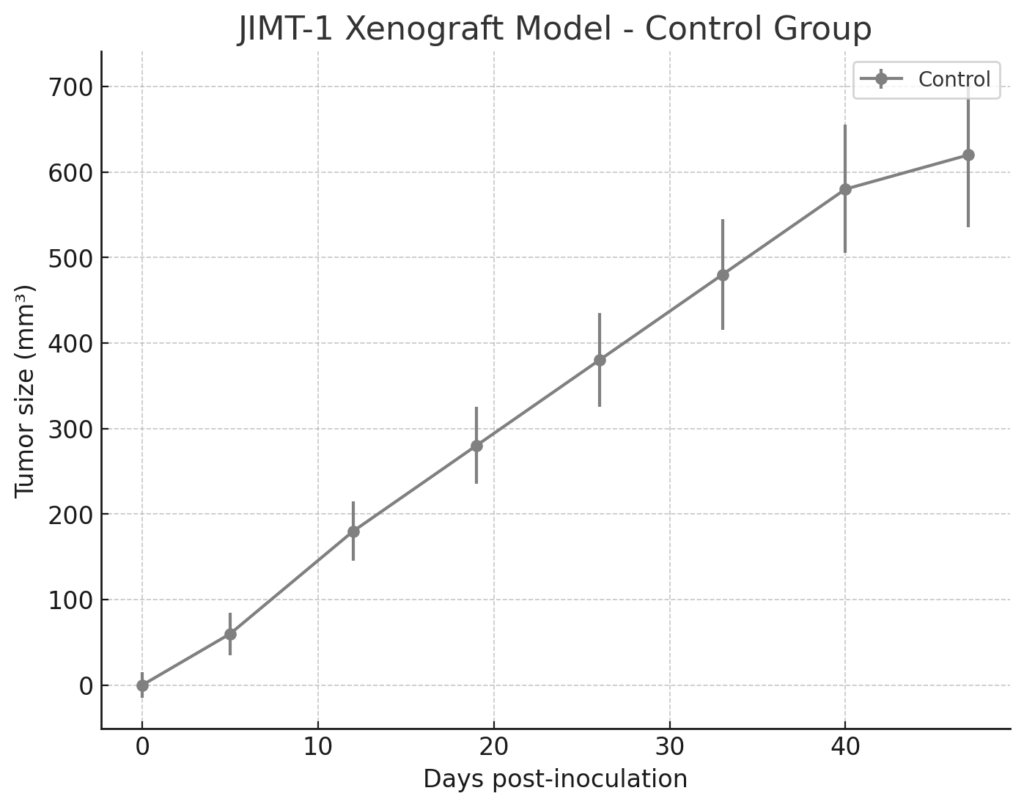
JIMT-1 xenografts are generated by subcutaneous implantation of 5 × 10^6 to 1 × 10^7 cells suspended in Matrigel into immunodeficient mice, such as athymic nude or NSG mice. Tumor take rates exceed 90%, with palpable tumors typically forming within 7–10 days post-injection. Final tumor volumes of 1,200–1,500 mm³ are usually reached within 4–5 weeks under untreated conditions.
The model supports orthotopic implantation into the mammary fat pad, providing a more relevant tumor microenvironment and enabling exploration of stromal-epithelial interactions, matrix remodeling, and drug delivery. Fluorescent or bioluminescent reporter tagging is also feasible and frequently used to enable real-time imaging of tumor burden and therapeutic response.
Importantly, HER2 overexpression is stably retained in vivo, and trastuzumab resistance persists under xenograft conditions, making the model appropriate for testing second-line HER2-targeted agents, ADCs, and signal transduction inhibitors.
Request a Custom Quote for JIMT-1 Xenograft ModelHistopathology and Immunohistochemical Profile
Histologically, JIMT-1 xenografts display solid sheets of moderately pleomorphic epithelial cells with large nuclei, prominent nucleoli, and high mitotic activity. Tumors are moderately vascularized and often exhibit central necrosis and regions of peritumoral fibrosis. The histological appearance aligns with high-grade ductal carcinoma.
Immunohistochemistry reveals strong membrane staining for HER2, absent ER and PR staining, and intense Ki-67 labeling with indices ranging from 50–70%. Phosphorylated AKT and ERK staining is prominent, confirming active downstream signaling. MUC4 is abundantly expressed at the cell surface, and survivin and BCL-2 positivity is consistently observed across tumor sections.
These features provide histological validation of HER2 signaling activity and resistance mechanisms and support the model’s use in resistance-targeting therapeutic studies.
Preclinical Applications and Drug Response
JIMT-1 xenografts are among the most widely used models for evaluating novel HER2-directed therapies in trastuzumab-refractory settings. The model has been used extensively to assess the efficacy of irreversible HER2 tyrosine kinase inhibitors (e.g., neratinib, afatinib), antibody-drug conjugates (e.g., T-DM1, trastuzumab deruxtecan), and dual HER2/EGFR targeting agents.
Because of its constitutively active PI3K/AKT/mTOR signaling, JIMT-1 is ideal for combination therapy studies pairing HER2 blockade with inhibitors of intracellular survival pathways. The model has also been used in co-treatment experiments involving immune checkpoint blockade, as MUC4 overexpression may modulate immune evasion.
Additional applications include evaluation of HER2 ubiquitination, receptor trafficking dynamics, epigenetic modifiers, and targeted approaches to overcome mucin-mediated resistance. Its tractable growth kinetics and reproducibility make it a benchmark model for late preclinical development.
Request This Model
To utilize the JIMT-1 xenograft model in studies of HER2 inhibitor resistance, alternative HER2-targeted therapies, or downstream pathway blockade, please use the custom quote request link below. Full support is available for subcutaneous and orthotopic tumor implantation, pharmacodynamic biomarker analysis, and multi-agent treatment protocols.
Request a Custom Quote for JIMT-1 Xenograft Model