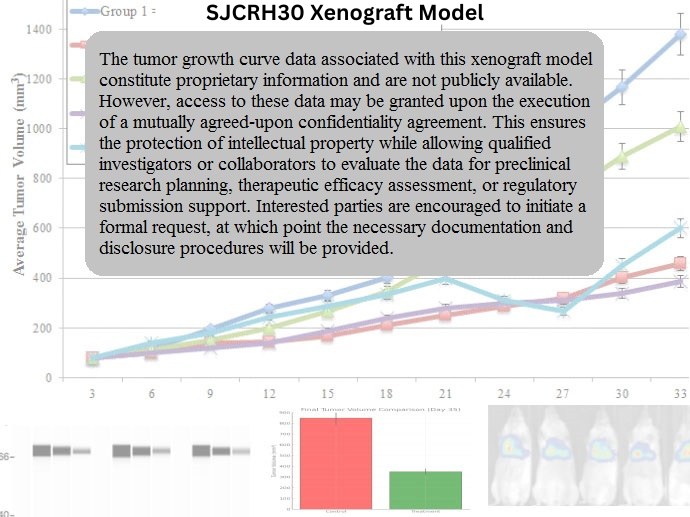
SJCRH30 Xenograft Model Overview
The SJCRH30 xenograft model is derived from a human rhabdomyosarcoma (RMS) cell line, SJCRH30, established from a patient with alveolar rhabdomyosarcoma, a subtype of RMS. Alveolar rhabdomyosarcoma is an aggressive, soft tissue sarcoma predominantly affecting children and adolescents. The SJCRH30 model replicates the key features of alveolar rhabdomyosarcoma, including the presence of the PAX3-FOXO1 fusion gene, which plays a central role in tumorigenesis, metastasis, and therapy resistance. Given its aggressive behavior and the genetic alterations present, the SJCRH30 xenograft model is widely used in preclinical research to investigate the biology of rhabdomyosarcoma, the mechanisms behind chemotherapy resistance, and the efficacy of novel therapeutic strategies, including chemotherapy, targeted therapies, and immunotherapies.
Request a Custom Quote for SJCRH30 Xenograft ModelBiological and Molecular Characteristics
SJCRH30 cells are characterized by the presence of the PAX3-FOXO1 fusion gene, a hallmark genetic alteration found in alveolar rhabdomyosarcoma. The PAX3-FOXO1 fusion gene results from a chromosomal translocation and leads to the deregulation of transcription factors that affect cell proliferation, survival, and apoptosis. The SJCRH30 model also expresses muscle-specific markers such as myogenin and desmin, which are indicative of rhabdomyosarcoma’s skeletal muscle differentiation. Additionally, SJCRH30 cells exhibit dysregulation of key signaling pathways, such as PI3K/AKT and MAPK/ERK, which promote cell survival, proliferation, and invasion. These molecular features make the SJCRH30 xenograft model an excellent platform for evaluating therapies that target the PAX3-FOXO1 fusion protein and associated downstream pathways.
| Marker | Expression Level | Function |
|---|---|---|
| PAX3-FOXO1 Fusion | Present | Oncogenic fusion protein driving tumorigenesis |
| Myogenin | High | Muscle differentiation marker |
| Desmin | High | Muscle marker involved in rhabdomyosarcoma |
| PI3K/AKT pathway | Dysregulated | Promotes cell survival and proliferation |
In Vivo Model Development and Tumorigenicity
The SJCRH30 xenograft model is typically established by implanting SJCRH30 cells into immunocompromised mice, such as NOD/SCID or NSG mice, which lack functional T and B cells. Upon implantation, the cells form solid tumors that replicate the clinical features of rhabdomyosarcoma, including high cellularity, the presence of rhabdomyoblasts, and significant vascularization. The tumors also show areas of necrosis due to the rapid growth of tumor cells. The SJCRH30 model is particularly useful for evaluating the efficacy of chemotherapy agents commonly used in the treatment of RMS, such as doxorubicin, cyclophosphamide, and vincristine, which are standard components of treatment regimens for rhabdomyosarcoma.
In addition to subcutaneous implantation, orthotopic models of SJCRH30 can be established by implanting the cells into skeletal muscle or soft tissues of immunocompromised mice. This orthotopic model more closely mimics the natural site of tumor growth, allowing for the study of tumor progression, local invasion, and metastatic spread. SJCRH30 xenografts are capable of metastasizing to distant organs, particularly the lungs, which makes this model highly relevant for studying metastatic disease and for evaluating therapies aimed at preventing or treating metastasis in rhabdomyosarcoma.
Request a Custom Quote for SJCRH30 Xenograft ModelHistopathology and Immunohistochemical Profile
Histopathological examination of SJCRH30 xenografts reveals the characteristic features of alveolar rhabdomyosarcoma, including a biphasic pattern with both small, round cells and larger, more differentiated tumor cells resembling skeletal muscle. The tumors also exhibit areas of necrosis, indicative of rapid tumor growth. Immunohistochemical staining of SJCRH30 xenografts shows strong expression of muscle-specific markers such as myogenin and desmin, confirming the skeletal muscle differentiation of the tumor. The presence of the PAX3-FOXO1 fusion protein can be detected using specific probes, confirming its role in tumorigenesis. Additionally, elevated levels of phosphorylated AKT are detected, indicating activation of the PI3K/AKT pathway, which contributes to cell survival and resistance to therapy. CD31 staining reveals significant vascularization, highlighting the tumor’s dependence on angiogenesis to support rapid growth.
Preclinical Applications and Drug Response
The SJCRH30 xenograft model is widely used to evaluate the efficacy of chemotherapy agents, including doxorubicin, cyclophosphamide, and vincristine, which are standard treatments for rhabdomyosarcoma. The model’s potential for developing resistance to chemotherapy over time makes it particularly useful for studying chemotherapy resistance mechanisms and for testing new agents aimed at overcoming these challenges. The SJCRH30 xenograft model is also valuable for evaluating targeted therapies, particularly those aimed at inhibiting the PAX3-FOXO1 fusion protein, which is critical for tumorigenesis in alveolar rhabdomyosarcoma.
In addition to chemotherapy and targeted therapies, the SJCRH30 xenograft model is increasingly used to evaluate the potential of immunotherapies, including immune checkpoint inhibitors and monoclonal antibodies targeting tumor-specific antigens. The model’s ability to replicate key features of rhabdomyosarcoma, including its biphasic tumor structure, aggressive growth, and metastatic potential, makes it an ideal platform for studying new treatment strategies. Furthermore, the ability of SJCRH30 xenografts to metastasize to the lungs provides an excellent opportunity to evaluate therapies aimed at preventing or treating metastatic disease, a critical challenge in rhabdomyosarcoma treatment.
Request This Model
To request the SJCRH30 xenograft model for your preclinical studies, please use the form below. A customized quote and additional model specifications will be provided upon inquiry.
Request a Custom Quote for SJCRH30 Xenograft Model