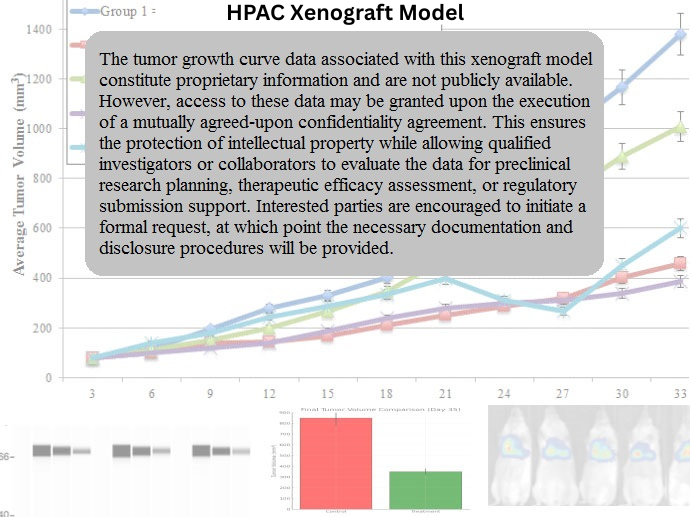
HPAC Xenograft Model Overview
The HPAC xenograft model is derived from a human pancreatic adenocarcinoma cell line, HPAC, established from a patient with pancreatic ductal adenocarcinoma (PDAC). PDAC is the most common and aggressive type of pancreatic cancer, and it is associated with a poor prognosis due to its resistance to most conventional therapies, late-stage diagnosis, and frequent metastasis. The HPAC xenograft model is an invaluable tool in preclinical research, enabling scientists to study the molecular mechanisms driving pancreatic cancer, its metastatic behavior, and the tumor’s response to various therapies. Given the model’s molecular characteristics and tumorigenic properties, the HPAC xenograft is widely used for testing chemotherapy agents, targeted therapies, and immunotherapies.
Request a Custom Quote for HPAC Xenograft ModelBiological and Molecular Characteristics
HPAC cells are characterized by their epithelial origin and express several markers typically associated with pancreatic adenocarcinoma, such as cytokeratins, epithelial membrane antigen (EMA), and the cancer-associated antigen CA19-9. The HPAC model has mutations in the KRAS gene, which is a hallmark of nearly 90% of pancreatic cancers, and it plays a critical role in the initiation, progression, and metastasis of pancreatic tumors. Additionally, HPAC cells exhibit loss of the tumor suppressor gene p53, a frequent mutation seen in PDAC that contributes to resistance to apoptosis and chemotherapy. The model also shows dysregulation in other signaling pathways, including PI3K/AKT and MAPK, which are involved in tumor cell survival, proliferation, and invasion. These features make the HPAC xenograft model particularly relevant for testing new treatments aimed at targeting these pathways or overcoming the resistance mechanisms present in pancreatic cancer.
| Marker | Expression Level | Function |
|---|---|---|
| Cytokeratin | High | Epithelial cell marker |
| EMA | High | Epithelial membrane antigen |
| CA19-9 | Elevated | Pancreatic cancer biomarker |
| KRAS | Mutated | Oncogene involved in tumor progression |
| PI3K/AKT pathway | Dysregulated | Promotes cell survival and proliferation |
In Vivo Model Development and Tumorigenicity
The HPAC xenograft model is typically established by subcutaneously injecting HPAC cells into immunocompromised mice, such as NOD/SCID or NSG mice, which lack functional T and B cells. Once implanted, the cells form tumors that closely resemble human pancreatic ductal adenocarcinoma, with high cellularity, significant necrosis, and abundant vascularization. The model is useful for studying the mechanisms of tumor growth and metastasis, as the HPAC cells have the ability to spread to distant organs such as the liver, lungs, and peritoneum. This makes the model highly relevant for studying metastatic disease, which is a hallmark of advanced pancreatic cancer.
In addition to subcutaneous implantation, the HPAC model can be established through orthotopic implantation, where the cells are injected into the pancreas of immunocompromised mice. This orthotopic model closely mimics the natural growth of PDAC and allows for the study of tumor progression, local invasion, and peritoneal dissemination. The model also offers the ability to evaluate therapies targeting the pancreatic tumor microenvironment, which includes interactions between tumor cells, stromal cells, and immune cells.
Request a Custom Quote for HPAC Xenograft ModelHistopathology and Immunohistochemical Profile
Histopathological analysis of HPAC xenografts reveals a characteristic morphology of pancreatic ductal adenocarcinoma, including glandular structures and areas of necrosis. The tumors are composed of pleomorphic cells with irregular nuclear morphology, high mitotic activity, and abundant cytoplasm. Immunohistochemical staining of HPAC xenografts shows strong expression of cytokeratins and EMA, confirming the epithelial origin of the tumor. Additionally, the tumors exhibit high levels of CA19-9, a biomarker commonly elevated in pancreatic cancer patients. The model also shows high expression of KRAS, reflecting the mutation of this oncogene, and elevated levels of phosphorylated AKT, indicating activation of the PI3K/AKT pathway, which is involved in the tumor’s survival and growth. The tumors are highly vascularized, as indicated by CD31 staining, and show signs of immune suppression, making them suitable for evaluating novel immunotherapies.
Preclinical Applications and Drug Response
The HPAC xenograft model is widely used to evaluate the efficacy of a variety of therapeutic agents, particularly chemotherapy drugs such as gemcitabine and cisplatin, which are commonly used to treat pancreatic cancer. Given the model’s sensitivity to chemotherapy, it is particularly useful for testing combination therapies aimed at overcoming resistance or improving therapeutic efficacy. The HPAC model is also valuable for testing targeted therapies aimed at key signaling pathways involved in PDAC progression, such as KRAS, PI3K/AKT, and MAPK/ERK.
In addition to chemotherapy and targeted therapies, the HPAC xenograft model is increasingly used to evaluate the effectiveness of immunotherapies, including immune checkpoint inhibitors (e.g., anti-PD-1, anti-PD-L1) and monoclonal antibodies targeting cancer-specific antigens. The model’s ability to replicate the immune-suppressive tumor microenvironment of PDAC makes it an ideal platform for testing these new immunotherapeutic approaches. Furthermore, the model is useful for investigating agents that target the tumor stroma, including fibroblast activation and collagen deposition, which play a significant role in the aggressive behavior of pancreatic tumors.
Request This Model
To request the HPAC xenograft model for your preclinical studies, please use the form below. A customized quote and additional model specifications will be provided upon inquiry.
Request a Custom Quote for HPAC Xenograft Model