Pfeiffer Xenograft Model Overview
The Pfeiffer xenograft model is derived from a human diffuse large B-cell lymphoma (DLBCL) cell line belonging to the germinal center B-cell–like (GCB) subtype, which is generally associated with a better prognosis than the activated B-cell–like (ABC) subtype. Isolated from the pleural effusion of a DLBCL patient, Pfeiffer cells exhibit phenotypic and molecular features characteristic of the GCB lineage, including expression of BCL6 and CD10. The xenograft model replicates key aspects of GCB-DLBCL biology in vivo, supporting translational research into B-cell receptor signaling, anti-apoptotic pathways, and the efficacy of novel immunotherapies and small-molecule inhibitors. The Pfeiffer model has emerged as a benchmark tool for evaluating subtype-specific vulnerabilities in GCB-DLBCL.
Request a Custom Quote for Pfeiffer Xenograft ModelBiological and Molecular Characteristics
Pfeiffer cells express canonical GCB-DLBCL markers such as CD10, BCL6, and CD19, while lacking MUM1/IRF4 expression. The cell line is EBV-negative and harbors the t(14;18)(q32;q21) chromosomal translocation, which leads to BCL2 overexpression and contributes to tumor cell survival. The cells retain surface CD20 and MHC class II expression, facilitating evaluation of CD20-targeted therapies and antigen presentation mechanisms. Pfeiffer cells are partially sensitive to BCL2 inhibition but also exhibit high levels of MYC and phospho-AKT, suggesting activation of compensatory survival pathways. This molecular complexity makes the model suitable for assessing monotherapy and combinatorial regimens targeting GCB-DLBCL.
| Characteristic | Description |
|---|---|
| Tissue Origin | Human diffuse large B-cell lymphoma (pleural effusion) |
| Subtype | Germinal center B-cell–like (GCB-DLBCL) |
| Immunophenotype | CD19+, CD20+, CD10+, BCL6+, MUM1–, HLA-DR+ |
| Key Alterations | t(14;18) BCL2 overexpression, MYC+, AKT activation |
| Therapeutic Relevance | BCL2 inhibition, CD20-targeting, PI3K/AKT inhibitors |
In Vivo Model Development and Tumorigenicity
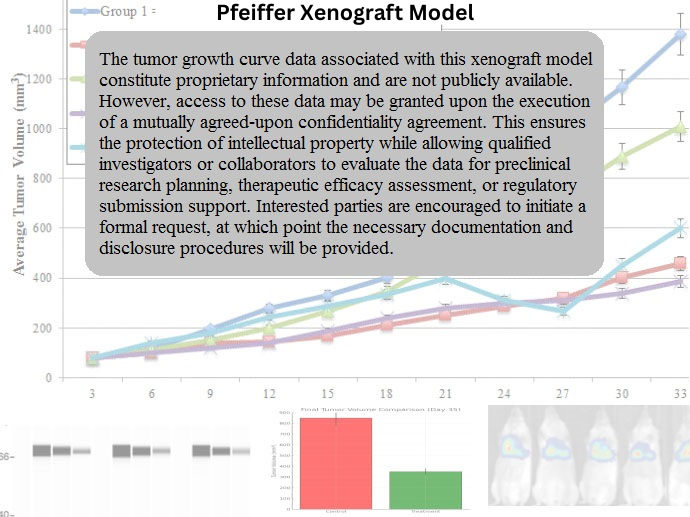
The Pfeiffer xenograft model is established through subcutaneous implantation of cells into immunodeficient mouse strains such as NOD/SCID or NSG. Tumor formation typically occurs within three to four weeks post-injection, with tumors reaching volumes of 400–800 mm³ within seven weeks. Tumors exhibit uniform growth across cohorts and moderate vascularization, providing a robust platform for pharmacological evaluations. The reproducibility and predictable kinetics of this model allow for time-course drug response studies, biomarker discovery, and comparative analyses with ABC-DLBCL models to delineate subtype-specific therapeutic outcomes.
Request a Custom Quote for Pfeiffer Xenograft ModelHistopathology and Immunohistochemical Profile
Histological examination of Pfeiffer xenografts reveals sheets of large neoplastic B cells with round nuclei, conspicuous nucleoli, and moderate cytoplasm. Hematoxylin and eosin staining demonstrates a diffuse infiltration pattern typical of high-grade lymphomas. Immunohistochemical staining confirms nuclear BCL6 and cytoplasmic CD20 positivity, along with a high Ki-67 proliferation index averaging between 70% and 90%. BCL2 is strongly expressed due to the t(14;18) translocation, while the absence of MUM1 expression helps confirm the GCB classification. The xenograft maintains key antigenic markers necessary for immune recognition and therapeutic antibody targeting.
Preclinical Applications and Drug Response
The Pfeiffer model serves as a critical system for preclinical evaluation of therapies tailored to the GCB-DLBCL subtype. It has been used to investigate the efficacy of CD20-directed therapies, such as rituximab and novel monoclonal antibodies, as well as agents targeting BCL2 and PI3K/AKT signaling pathways. The presence of MYC and AKT pathway activation has supported exploration of dual-pathway inhibitors and synthetic lethality-based approaches. The model’s consistent growth, well-defined molecular features, and subtype specificity make it well-suited for therapeutic validation, resistance mechanism studies, and translational research involving GCB-DLBCL.
Request This Model
To request the Pfeiffer xenograft model for your preclinical studies, please use the form below. A customized quote and additional model specifications will be provided upon inquiry.
Request a Custom Quote for Pfeiffer Xenograft Model