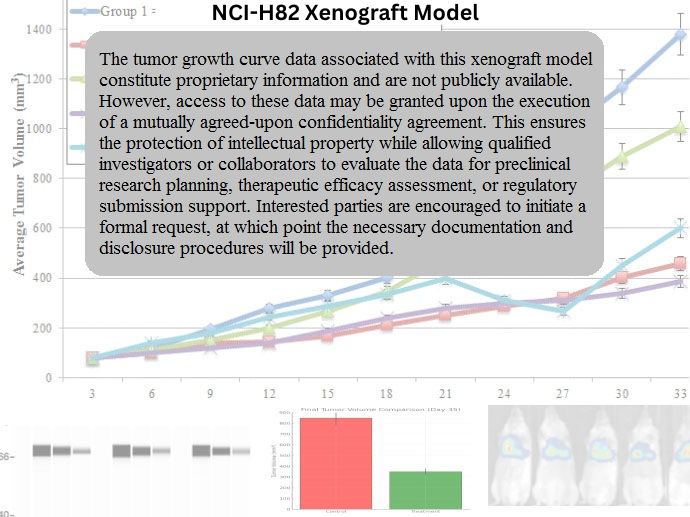
NCI-H82 Xenograft Model Overview
The NCI-H82 xenograft model is derived from a human small cell lung carcinoma (SCLC) and is widely recognized for its utility in modeling high-grade neuroendocrine tumors with rapid proliferation and poor prognosis. As an aggressive SCLC subtype, NCI-H82 exhibits characteristic features such as loss of tumor suppressors, neuroendocrine differentiation, and resistance to standard therapies. This xenograft model supports in vivo evaluation of both first-line chemotherapeutics and investigational agents that target apoptotic signaling, epigenetic regulation, or immune escape. Its high tumor take rate and consistent growth kinetics make it a foundational tool for translational lung cancer research.
Request a Custom Quote for NCI‑H82 Xenograft ModelBiological and Molecular Characteristics
NCI-H82 cells are morphologically small and round, growing in suspension culture and displaying scant cytoplasm with hyperchromatic nuclei. These cells strongly express neuroendocrine lineage markers including neuron-specific enolase (NSE), chromogranin A, and synaptophysin. Genetically, the cell line features biallelic inactivation of TP53 and RB1, which are defining genetic alterations in SCLC. Additional characteristics include MYC amplification and loss of HLA class I surface molecules, contributing to immune system evasion and unchecked proliferation. NCI-H82 has also been studied for its plasticity between neuroendocrine and non-neuroendocrine phenotypes, a hallmark of therapeutic resistance in SCLC.
| Characteristic | NCI-H82 Cell Line Profile |
|---|---|
| Tumor Type | Small cell lung carcinoma (SCLC) |
| Growth Pattern | Suspension |
| Neuroendocrine Markers | NSE⁺, Chromogranin A⁺, Synaptophysin⁺ |
| Key Genetic Alterations | TP53⁻/⁻, RB1⁻/⁻, MYC⁺ |
| MHC Class I Expression | Low/Absent |
In Vivo Model Development and Tumorigenicity
The NCI-H82 xenograft is typically established through subcutaneous injection into immunocompromised mouse strains such as athymic nude or NOD/SCID mice. Tumors form within 10–14 days and exhibit exponential growth kinetics, often requiring endpoint measurements within 3–4 weeks. The model demonstrates a highly reproducible engraftment rate, making it well-suited for studies involving drug dose-response, time-course analysis, or biomarker validation. Due to its rapid growth and aggressive histology, this model is often used in fast-paced therapeutic screening workflows and combination therapy trials.
Request a Custom Quote for NCI‑H82 Xenograft ModelHistopathology and Immunohistochemical Profile
Histological analysis of NCI-H82 xenograft tumors reveals densely packed sheets of small round blue cells, high mitotic activity, and extensive necrosis, reflecting the morphology of poorly differentiated neuroendocrine carcinoma. Immunohistochemistry shows strong and diffuse expression of synaptophysin, chromogranin A, and NSE, alongside high nuclear Ki-67 staining, indicating a proliferation index often exceeding 80%. Loss of RB and p53 expression can be confirmed via immunohistochemistry or western blot, aligning with the molecular etiology of patient-derived SCLC samples.
Preclinical Applications and Drug Response
The NCI-H82 xenograft model has been extensively utilized to test platinum-based chemotherapy, particularly cisplatin and etoposide, as well as emerging second-line options including lurbinectedin and topotecan. It serves as a critical platform for evaluating BCL2 inhibitors, DNA damage repair inhibitors (e.g., PARP inhibitors), EZH2-targeting compounds, and novel immune-modulatory approaches such as STING agonists and antigen-presentation enhancers. Additionally, this model is used to investigate lineage plasticity in SCLC and mechanisms underlying the neuroendocrine-to-nonneuroendocrine transition observed in treatment-resistant disease.
Request This Model
Researchers working on aggressive lung cancers can rely on the NCI-H82 xenograft model for rigorous preclinical testing of drug candidates. Contact us to obtain tumor growth data, histological images, and expert support in developing customized in vivo study designs.
Request a Custom Quote for NCI‑H82 Xenograft Model