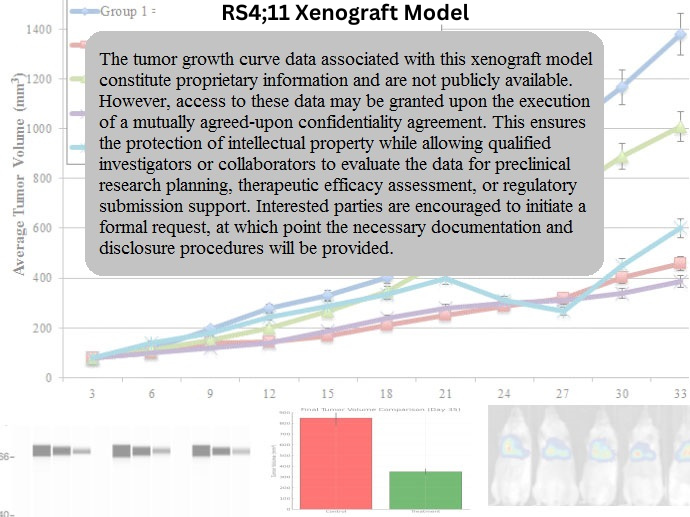
RS4;11 Xenograft Model Overview
The RS4;11 xenograft model is derived from a human acute lymphoblastic leukemia (ALL) cell line established from the bone marrow of a 32-year-old female patient with B-cell precursor ALL. This cell line is characterized by the presence of the chromosomal translocation t(4;11)(q21;q23), which results in the MLL-AF4 fusion gene—a defining feature of high-risk, therapy-resistant B-ALL, especially in infants and young adults. The RS4;11 xenograft model provides an in vivo platform that recapitulates key clinical and molecular features of MLL-rearranged leukemia, including aggressive proliferation, high tumor burden, and resistance to conventional chemotherapeutics. This model is highly valued for preclinical evaluation of epigenetic therapies, CDK inhibitors, and investigational agents targeting MLL fusion–driven transcriptional dysregulation.
Request a Custom Quote for RS4;11 Xenograft ModelBiological and Molecular Characteristics
RS4;11 cells exhibit suspension growth and display a round, lymphoblast-like morphology with a high nuclear-to-cytoplasmic ratio. Immunophenotypically, the cell line is positive for early B-cell markers such as CD19, CD22, CD79a, and HLA-DR, while also expressing CD10 and CD38. The hallmark MLL-AF4 translocation drives constitutive expression of HOXA9, MEIS1, and other downstream oncogenic effectors associated with leukemogenesis. RS4;11 cells are p53 wild-type and exhibit sensitivity to DNA damage, but show intrinsic resistance to several glucocorticoids and anthracyclines, reflecting their clinical chemoresistance. The cell line’s transcriptional landscape is consistent with high-risk B-ALL, enabling mechanistic studies of MLL fusion–mediated leukemic transformation.
| Characteristic | RS4;11 Cell Line Profile |
|---|---|
| Disease Origin | B-cell precursor acute lymphoblastic leukemia (B-ALL) |
| Key Genetic Feature | t(4;11)(q21;q23), MLL-AF4 fusion gene |
| Immunophenotype | CD19⁺, CD22⁺, CD79a⁺, CD10⁺, HLA-DR⁺, CD38⁺ |
| Transcriptional Profile | HOXA9⁺, MEIS1⁺, FLT3⁺ |
| p53 Status | Wild-type |
| Chemoresistance Profile | Glucocorticoid and anthracycline partial resistance |
In Vivo Model Development and Tumorigenicity
The RS4;11 xenograft model is typically generated by intravenous injection into NSG or NOD/SCID mice, resulting in systemic leukemia that involves the bone marrow, spleen, liver, and, in advanced cases, the central nervous system. Leukemic engraftment is highly reproducible, with disease burden becoming detectable within three to four weeks post-inoculation. The model is particularly useful for evaluating leukemia progression, pharmacokinetics, and therapeutic efficacy in a disseminated setting. While subcutaneous tumors can be generated for volume-based assessments, systemic models more accurately mirror clinical B-ALL and are favored for translational drug evaluation.
Request a Custom Quote for RS4;11 Xenograft ModelHistopathology and Immunohistochemical Profile
Histological sections of RS4;11-engrafted tissues reveal diffuse infiltration of small to medium-sized blasts with condensed chromatin, scant cytoplasm, and high mitotic activity. In bone marrow and spleen, normal architecture is often replaced by densely packed leukemic cells. Immunohistochemical staining confirms expression of B-lineage markers, particularly CD19 and CD22, and proliferative activity is evidenced by strong Ki-67 nuclear labeling. MLL fusion–driven transcriptional targets, such as HOXA9 and MEIS1, are detectable at the protein level via immunoblotting or RNA in situ hybridization. This histopathologic and molecular fidelity supports the model’s application in mechanistic and therapeutic studies of MLL-rearranged ALL.
Preclinical Applications and Drug Response
The RS4;11 xenograft model is widely employed in preclinical testing of agents targeting epigenetic modifiers (e.g., DOT1L, BRD4, and LSD1), CDK9 inhibitors, and apoptosis regulators such as BCL2 and MCL1. It is also used in studies evaluating antibody-based therapies targeting CD19 and CD22, including CAR-T and bispecific antibodies. Resistance to standard chemotherapy makes RS4;11 ideal for modeling high-risk ALL and identifying drug combinations that can overcome refractoriness. Its well-defined oncogenic signature and engraftment reproducibility make it particularly suited for evaluating transcriptional inhibitors, synthetic lethal interactions, and relapse mechanisms in MLL-AF4–positive leukemia.
Request This Model
To incorporate the RS4;11 xenograft model into your B-ALL drug development or mechanistic studies, contact our scientific team to obtain detailed model specifications and assistance with study design tailored to MLL-rearranged leukemia research.
Request a Custom Quote for RS4;11 Xenograft Model