SW837 Xenograft Model Overview
The SW837 xenograft model is derived from a human rectal adenocarcinoma cell line established from a primary tumor in a 60-year-old male patient. As a rectal carcinoma-derived system, SW837 provides a region-specific model for colorectal cancer research, particularly in contexts where anatomical and molecular distinctions between colon and rectal cancer influence therapeutic design. This model exhibits moderate differentiation, robust epithelial characteristics, and predictable growth in vivo, making it a valuable platform for testing chemotherapeutics, radiation sensitizers, and targeted agents in microsatellite-stable (MSS), KRAS-mutant colorectal cancer. The SW837 xenograft retains the biological complexity and histologic architecture of primary rectal adenocarcinomas, enabling its use in studies focused on biomarker development, resistance mechanisms, and rectum-specific treatment response.
Request a Custom Quote for SW837 Xenograft ModelBiological and Molecular Characteristics
SW837 cells display an epithelial monolayer morphology with strong expression of tight junction proteins and cell adhesion molecules, including E-cadherin and β-catenin. The line is microsatellite stable and harbors a KRAS G12C mutation, which contributes to resistance to EGFR-targeted therapies and sustained activation of the MAPK signaling cascade. TP53 is mutated, which may interfere with canonical apoptotic responses following DNA damage. The cell line expresses moderate levels of carcinoembryonic antigen (CEA), cytokeratin 20 (CK20), and other markers characteristic of intestinal epithelial differentiation. These features provide a clinically relevant molecular context for preclinical research in rectal cancers exhibiting KRAS-driven signaling and p53 pathway disruption.
| Characteristic | SW837 Cell Line Profile |
|---|---|
| Tissue of Origin | Rectal adenocarcinoma (primary tumor) |
| KRAS Status | Mutant (G12C) |
| TP53 Status | Mutated |
| MSI Status | Microsatellite stable (MSS) |
| Differentiation Markers | CK20, CEA, E-cadherin |
| MAPK Pathway Activity | Constitutively active |
In Vivo Model Development and Tumorigenicity
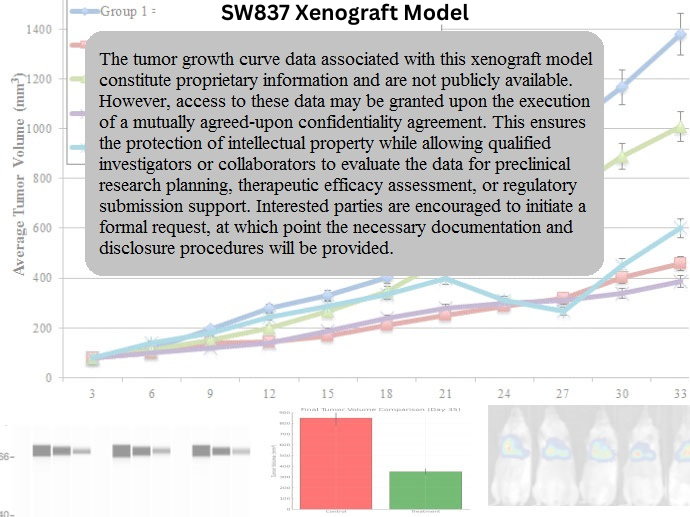
SW837 xenografts are developed by subcutaneous injection of cultured cells into immunodeficient mice, such as athymic nude or NOD/SCID strains. Tumor engraftment is highly consistent, with growth detectable within 8 to 12 days post-inoculation and tumor volumes typically reaching 700–900 mm³ within 4 to 5 weeks. The model’s stable growth kinetics and moderate proliferation rate make it suitable for multi-cycle therapeutic studies and radiation combination experiments. As a rectal cancer-derived line, SW837 xenografts are also appropriate for comparative studies against colon-derived models to evaluate anatomical subtype-specific drug response or resistance. The presence of a KRAS G12C mutation further supports its application in testing next-generation inhibitors targeting this actionable oncogenic driver.
Request a Custom Quote for SW837 Xenograft ModelHistopathology and Immunohistochemical Profile
Histologically, SW837 xenografts exhibit moderately differentiated adenocarcinoma morphology with glandular formation, occasional mucin production, and focal areas of central necrosis. Tumor cells display columnar architecture with basally located nuclei and eosinophilic cytoplasm, consistent with rectal epithelial lineage. Immunohistochemical staining reveals strong membranous E-cadherin and moderate expression of β-catenin, with partial cytoplasmic localization indicative of active Wnt signaling. CK20 and CEA positivity confirm the colorectal origin of the xenografts. Aberrant nuclear accumulation of mutant p53 is frequently observed, while proliferative activity is moderate as evidenced by Ki-67 labeling. The overall histologic profile of SW837 tumors supports its classification as a regionally specific, moderately differentiated colorectal cancer model.
Preclinical Applications and Drug Response
The SW837 xenograft model is ideally suited for studies targeting KRAS G12C–mutant colorectal cancer. Its resistance to EGFR inhibitors such as cetuximab parallels clinical outcomes in KRAS-mutant rectal tumors, providing a translationally relevant platform for testing alternative therapeutic strategies. Recent advances in KRAS G12C–specific inhibitors, including covalent allosteric agents, can be evaluated using this model for efficacy, pharmacokinetics, and resistance profiling. The mutated TP53 pathway further enables investigation of synthetic lethality strategies and combination regimens involving DNA repair inhibitors. Due to its rectal origin, the model may also be applied in radiation sensitization studies and rectum-specific drug screening efforts. Its molecular and histological stability allow for long-term, high-resolution analyses of therapeutic impact in a reproducible rectal cancer context.
Request This Model
To access the SW837 xenograft model for region-specific colorectal cancer research or targeted therapy development, contact our scientific team for detailed model specifications and customized study support.
Request a Custom Quote for SW837 Xenograft Model