SW 48 Xenograft Model Overview
The SW 48 xenograft model is established from a human colorectal adenocarcinoma cell line originally derived from a primary colon tumor of a 82-year-old Caucasian female. Distinguished by its microsatellite instability-high (MSI-H) phenotype and epithelial morphology, SW 48 offers a clinically relevant model for evaluating therapies targeting mismatch repair-deficient colorectal cancer. This xenograft system is particularly suited for investigating immunotherapy, DNA repair mechanisms, and checkpoint inhibitor responsiveness, as MSI-H colorectal tumors represent a distinct molecular and therapeutic subclass. With stable in vivo growth and preserved histological features, the SW 48 model has become an important tool for translational oncology programs focused on biomarker-driven colorectal cancer therapies.
Request a Custom Quote for SW 48 Xenograft ModelBiological and Molecular Characteristics
SW 48 cells exhibit an epithelial monolayer phenotype with tight junction formation and moderate cell–cell adhesion. The line is microsatellite instability-high (MSI-H) due to mutations in the mismatch repair (MMR) genes, particularly MLH1, leading to impaired DNA repair capacity and increased neoantigen burden. This renders the model highly immunogenic in clinical contexts, though it requires immunodeficient hosts for in vivo use. SW 48 cells are wild-type for KRAS, NRAS, and BRAF, which differentiates them from the majority of colorectal models harboring RAS-pathway mutations. TP53 is mutated, contributing to altered apoptotic responses. These features make SW 48 well-suited for exploring mechanisms of immunotherapy responsiveness, genome instability, and pharmacologic targeting of DNA repair pathways.
| Characteristic | SW 48 Cell Line Profile |
|---|---|
| Tissue of Origin | Colorectal adenocarcinoma (primary) |
| MSI Status | High (MSI-H) |
| KRAS/NRAS/BRAF Status | Wild-type |
| TP53 Status | Mutated |
| MMR Deficiency | MLH1-deficient |
| Growth Characteristics | Epithelial, adherent |
In Vivo Model Development and Tumorigenicity
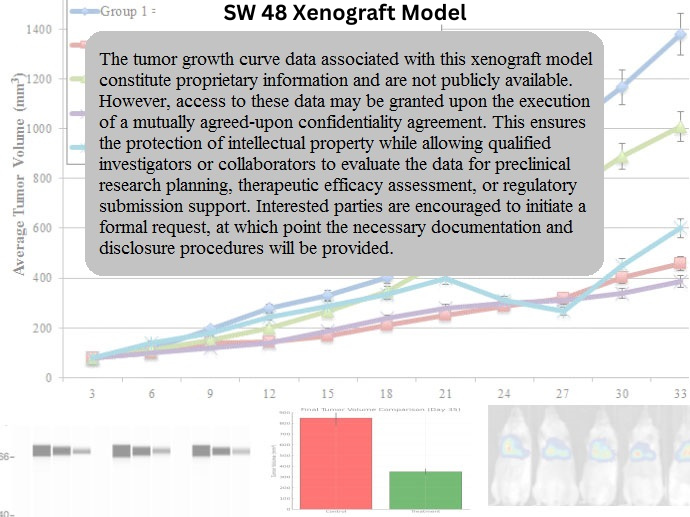
The SW 48 xenograft model is developed through subcutaneous implantation of cultured cells into immunodeficient mouse strains, such as athymic nude or NOD/SCID mice. Tumor formation generally initiates within 10 to 14 days, with growth reaching volumes of 700 to 900 mm³ over a 5- to 6-week window. Due to the MSI-H status and associated mutational burden, the SW 48 model offers unique advantages for testing DNA-damaging agents, PARP inhibitors, and immunotherapy-sensitizing regimens. Tumors grow with moderate kinetics and demonstrate consistent volumetric expansion in untreated control groups. The model’s mismatch repair deficiency contributes to tumor heterogeneity, mimicking clinical features of MSI-H colorectal carcinoma and supporting its application in biomarker stratification studies.
Request a Custom Quote for SW 48 Xenograft ModelHistopathology and Immunohistochemical Profile
Histopathological examination of SW 48 xenografts reveals moderately differentiated adenocarcinomas with tubular and glandular structures, central necrosis, and regions of nuclear pleomorphism—features characteristic of MSI-H colorectal tumors. Hematoxylin and eosin staining highlights epithelial polarity and glandular formation, while immunohistochemistry confirms strong CK20 and epithelial membrane antigen (EMA) expression. Nuclear staining for Ki-67 reveals moderate proliferative index, and aberrant p53 accumulation reflects underlying mutation. Loss of MLH1 protein expression, a defining feature of the cell line, is consistently observed in xenograft sections. These attributes underscore the translational relevance of SW 48 for preclinical studies targeting DNA repair deficiencies and mismatch repair-driven tumor phenotypes.
Preclinical Applications and Drug Response
The SW 48 xenograft model is highly relevant for evaluating therapies in MSI-H colorectal cancer, which represents approximately 15% of sporadic CRC cases. It is frequently employed in the development of immune checkpoint inhibitors, DNA repair inhibitors, and chemotherapies that exploit hypermutated tumor phenotypes. The model’s intact KRAS, NRAS, and BRAF status makes it sensitive to EGFR-targeted therapies, though TP53 mutation may limit apoptotic signaling. SW 48 is also used in preclinical studies of tumor mutational burden (TMB), neoantigen presentation, and resistance mechanisms to immune-modulating treatments. Its reproducible tumor growth and molecular fidelity allow it to serve as a benchmark model for MSI-H CRC drug discovery and validation efforts, particularly in studies requiring differentiation from microsatellite-stable comparator models.
Request This Model
To incorporate the SW 48 xenograft model into preclinical research targeting mismatch repair-deficient colorectal cancer, contact our scientific team for custom study development and model access.
Request a Custom Quote for SW 48 Xenograft Model