Caco-2 Xenograft Model Overview
The Caco-2 xenograft model is derived from a human colorectal adenocarcinoma cell line originally isolated from a 72-year-old male with primary colon cancer. While Caco-2 cells are widely recognized for their use in in vitro models of intestinal permeability and drug absorption due to their ability to differentiate into enterocyte-like monolayers, they also serve as a reliable in vivo xenograft model in colorectal cancer research. When cultured under standard conditions, Caco-2 cells spontaneously differentiate, making the xenograft model particularly relevant for studying the relationship between tumor cell differentiation and treatment response. The Caco-2 xenograft model is employed in evaluating anticancer agents that target well-differentiated colorectal epithelium, drug metabolism, transporter expression, and epithelial-specific signaling pathways.
Request a Custom Quote for Caco-2 Xenograft ModelBiological and Molecular Characteristics
Caco-2 cells exhibit features of highly differentiated colorectal epithelium, including brush border enzyme expression, tight junction formation, and high levels of polarized E-cadherin. The cell line is microsatellite stable and characterized by wild-type KRAS and BRAF, while TP53 is mutated, which influences apoptotic signaling and sensitivity to genotoxic agents. Caco-2 cells express numerous drug-metabolizing enzymes and ATP-binding cassette (ABC) transporters, including P-glycoprotein (MDR1), MRP2, and BCRP, which are retained in xenografts and make the model ideal for evaluating drug absorption, efflux, and bioavailability. The combination of epithelial differentiation and complex transporter profile supports its dual role as a pharmacological and oncological model.
| Characteristic | Caco-2 Cell Line Profile |
|---|---|
| Tissue of Origin | Colorectal adenocarcinoma (primary) |
| KRAS/BRAF Status | Wild-type |
| TP53 Status | Mutated |
| MSI Status | Microsatellite stable (MSS) |
| Differentiation Potential | High (enterocyte-like phenotype) |
| ABC Transporter Expression | MDR1, MRP2, BCRP |
In Vivo Model Development and Tumorigenicity
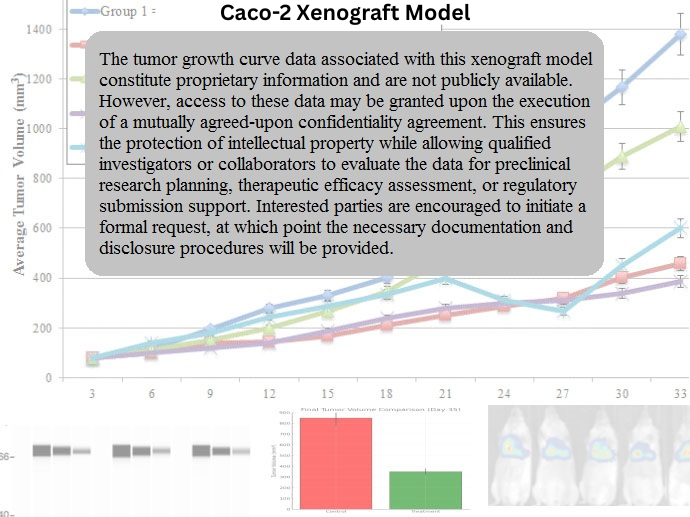
Caco-2 xenografts are typically developed by subcutaneous injection of cultured cells into immunocompromised mice, such as athymic nude or NOD/SCID models. Although the tumor take rate is moderate, once established, Caco-2 xenografts grow with reliable kinetics, achieving tumor volumes of 700–900 mm³ over a period of approximately five weeks. Due to the cell line’s high degree of differentiation and lower proliferative index compared to less differentiated colorectal models, tumor progression is slower and more stable. This makes the model ideal for long-term efficacy studies, drug metabolism investigations, and experiments assessing epithelial polarity and transport. The in vivo retention of brush border characteristics and tight junctions offers a distinctive advantage for studies of intestinal epithelial-targeting therapeutics.
Request a Custom Quote for Caco-2 Xenograft ModelHistopathology and Immunohistochemical Profile
Histologically, Caco-2 xenografts display well-differentiated glandular architecture with prominent luminal structures and brush border formation, recapitulating features of normal intestinal epithelium. Hematoxylin and eosin (H&E) staining shows columnar epithelial cells organized in tubular formations, often surrounded by sparse stromal elements. Immunohistochemical staining reveals strong expression of epithelial markers including CK20, E-cadherin, and villin. Brush border enzymes such as alkaline phosphatase and sucrase-isomaltase are detectable in xenograft tissues, confirming functional differentiation. P-glycoprotein and other ABC transporters demonstrate apical membrane localization, validating the use of this model in transporter-targeted pharmacokinetic studies. The histologic fidelity to human intestinal epithelium underlies the model’s value in both cancer biology and drug delivery research.
Preclinical Applications and Drug Response
The Caco-2 xenograft model is employed in diverse applications, ranging from colorectal cancer drug efficacy studies to preclinical assessments of intestinal drug metabolism and transporter function. Its wild-type KRAS and BRAF status makes it responsive to EGFR-targeted therapies, unlike models with RAS-pathway mutations. However, TP53 mutation can influence susceptibility to DNA-damaging agents and radiation therapy. Due to the expression of multiple efflux transporters, Caco-2 xenografts are particularly useful for testing bioavailability-enhancing formulations, drug-drug interactions, and strategies to overcome P-glycoprotein-mediated resistance. Moreover, its high differentiation status supports studies of enterocyte-targeting biologics and oral drug candidates that require evaluation in a physiologically relevant epithelial context. This model is well suited for dual-purpose oncology-pharmacology pipelines seeking to merge efficacy and ADME (absorption, distribution, metabolism, and excretion) profiling within a single in vivo system.
Request This Model
To explore therapeutic or pharmacokinetic applications using the highly differentiated Caco-2 xenograft model, contact our scientific team to initiate a customized preclinical study or request model access.
Request a Custom Quote for Caco-2 Xenograft Model