BT-20 Xenograft Model Overview
The BT-20 xenograft model is derived from a primary breast carcinoma and is widely recognized as a prototypical model of basal-like, triple-negative breast cancer (TNBC). Isolated from a 74-year-old female with invasive ductal carcinoma, BT-20 cells represent a poorly differentiated, aggressive TNBC subtype lacking expression of estrogen receptor (ER), progesterone receptor (PR), and HER2. The model is characterized by a high degree of genomic instability, elevated proliferation, and epithelial-to-mesenchymal transition (EMT) traits.
BT-20 xenografts are commonly used to study chemoresistance, PI3K pathway inhibition, and tumor plasticity in TNBC. The model recapitulates key features of high-grade basal-like tumors, including rapid proliferation, loss of hormone responsiveness, and constitutive activation of survival pathways. Its moderate tumorigenic efficiency and heterogeneous growth pattern make it ideal for dissecting clonal selection under therapeutic pressure.
Request a Custom Quote for BT-20 Xenograft ModelBiological and Molecular Characteristics
BT-20 cells are classified within the basal A subtype of TNBC, distinguished by expression of cytokeratins CK5/6 and EGFR, and lack of luminal differentiation markers. Genetically, BT-20 cells exhibit a homozygous deletion of PTEN, leading to constitutive PI3K/AKT/mTOR pathway activation. They also harbor TP53 mutations and frequent chromosomal aberrations consistent with genomic instability.
The BT-20 cell line retains epithelial morphology but displays partial EMT characteristics, including variable expression of mesenchymal markers and low levels of E-cadherin. It has a high mutational burden, rendering it a valuable model for evaluating synthetic lethal strategies and multi-targeted combination therapies.
| Characteristic | BT-20 Profile |
|---|---|
| Tumor Type | Human primary ductal breast carcinoma |
| Receptor Status | ER–, PR–, HER2– (TNBC) |
| Molecular Subtype | Basal A (cytokeratin 5/6+, EGFR+) |
| PTEN Status | Deleted |
| TP53 Status | Mutant |
| PI3K/AKT Pathway | Constitutively activated |
| Growth Pattern | Epithelial with partial EMT features |
| Proliferation Index | High (Ki-67 > 60%) |
| Genetic Stability | Low (frequent chromosomal gains/losses) |
| Doubling Time | ~26–30 hours (in vitro); moderate in vivo growth rate |
These molecular features position BT-20 as a high-fidelity model for basal-like TNBC and therapeutic resistance profiling.
In Vivo Model Development and Tumorigenicity
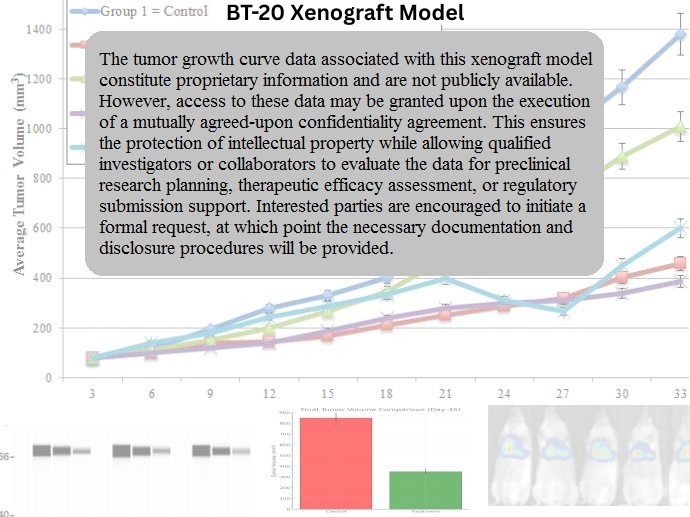
BT-20 xenografts are typically generated by subcutaneous injection of 5–10 × 10⁶ cells into immunocompromised mice such as athymic nude or NOD/SCID strains. Tumor take rates are moderate (~70–80%) and can be enhanced with Matrigel or co-injection with fibroblasts. Tumors become palpable within 10–14 days and typically reach endpoint volumes (1,200–1,500 mm³) within 4–6 weeks.
Orthotopic transplantation into the mammary fat pad is feasible but less commonly used due to slower tumor kinetics compared to basal B models. BT-20 tumors often display heterogeneous morphology and partial stromal encapsulation, which can influence drug penetration and response.
The model is well suited for long-term studies, recurrence modeling, and comparative analysis of treatment regimens targeting cell cycle progression, PI3K/mTOR signaling, and apoptotic resistance.
Request a Custom Quote for BT-20 Xenograft ModelHistopathology and Immunohistochemical Profile
BT-20 xenografts demonstrate histological features of poorly differentiated ductal carcinoma, with irregular glandular structures, pleomorphic nuclei, and a high mitotic index. Areas of necrosis and hemorrhage may be present in rapidly growing tumors. The tumor architecture is moderately cohesive but punctuated by regions of disorganization and cellular atypia.
Immunohistochemically, BT-20 xenografts are negative for ER, PR, and HER2. E-cadherin expression is reduced or patchy, while vimentin is variably expressed, indicating partial EMT. Cytokeratin 5/6 and EGFR are strongly positive, supporting basal A classification. Ki-67 staining is consistently high, and phospho-AKT/ERK expression confirms survival pathway activation. Cleaved caspase-3 and BAX are detectable following effective cytotoxic therapy, validating their use as pharmacodynamic endpoints.
This immunoprofile supports the model’s utility for testing anti-proliferative, pathway-specific, and EMT-targeted therapies in TNBC.
Preclinical Applications and Drug Response
BT-20 xenografts are widely used in preclinical studies focused on TNBC drug discovery, particularly in areas involving PI3K/AKT/mTOR inhibition, synthetic lethality, and chemoresistance reversal. Their intrinsic resistance to standard chemotherapies such as paclitaxel and doxorubicin provides a platform to investigate novel sensitization strategies.
The model responds moderately to PI3K and dual PI3K/mTOR inhibitors due to its PTEN deletion. BT-20 xenografts have also been used in studies of CDK4/6 inhibitors, HDAC inhibitors, and immune checkpoint blockade in combination settings. Given the model’s genomic instability, it is suitable for assessing mutational burden as a predictor of response and for identifying adaptive resistance pathways.
BT-20 is increasingly applied in combination therapy testing, including agents that target metabolic adaptation, redox balance, and autophagy. Its moderate growth kinetics also make it ideal for evaluating tumor dormancy and residual disease following incomplete response.
Request This Model
To incorporate the BT-20 xenograft model into triple-negative breast cancer research or drug screening programs, request a customized service package below. Available services include tumor engraftment, molecular profiling, and pharmacologic evaluation of targeted and combinatorial regimens.
Request a Custom Quote for BT-20 Xenograft Model