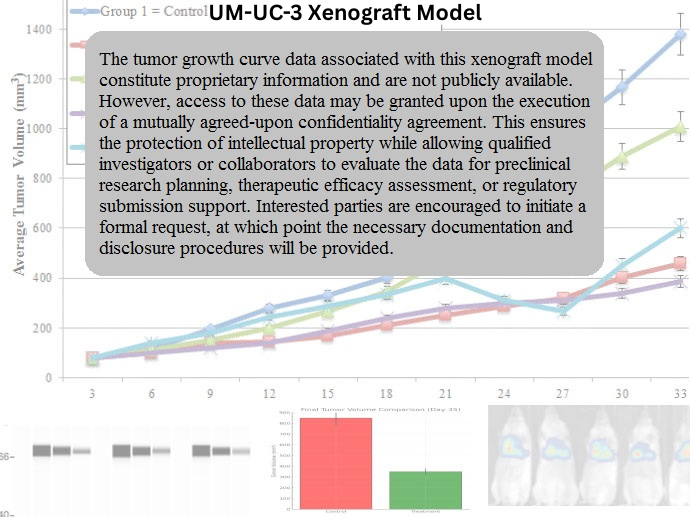
UM-UC-3 Xenograft Model Overview
The UM-UC-3 xenograft model is derived from a high-grade transitional cell carcinoma of the human urinary bladder and is widely regarded as one of the most aggressive and rapidly proliferating bladder cancer models available for in vivo research. Originally isolated from a metastatic lymph node lesion in a male patient with poorly differentiated bladder carcinoma, the UM-UC-3 cell line exhibits a mesenchymal-like, basal molecular profile with limited epithelial differentiation. It is extensively used to model advanced, muscle-invasive bladder cancer (MIBC), particularly in preclinical studies aiming to investigate chemoresistance, metastatic behavior, and oncogenic signaling networks driving urothelial transformation.
In vivo, UM-UC-3 xenografts demonstrate rapid and consistent tumor formation with high cellular density, aggressive infiltration, and poor differentiation. These tumors mirror many of the clinical features of late-stage urothelial carcinoma, including an impaired DNA damage response, deregulated cell cycle checkpoints, and a high propensity for proliferative and invasive signaling. The model is frequently employed in therapeutic efficacy testing, particularly for agents targeting the PI3K/AKT, RAS/RAF/MEK, and DNA repair pathways. Its reproducibility, metastatic capacity (under specific conditions), and compatibility with multiple implantation techniques make it a cornerstone in urothelial cancer research.
Request a Custom Quote for UM-UC-3 Xenograft ModelBiological and Molecular Characteristics
UM-UC-3 cells exhibit a basal-like phenotype with loss of epithelial markers and upregulation of mesenchymal and stem-like traits, making them ideal for modeling aggressive, undifferentiated bladder cancers. The cell line is p53-null due to a homozygous deletion and demonstrates RB1 loss, contributing to unchecked cell cycle progression and resistance to apoptosis. It also lacks PTEN, resulting in constitutive activation of the PI3K/AKT pathway. Mutational analysis shows activating alterations in HRAS and dysregulated expression of downstream effectors including cyclin D1, CDK4, and BCL-2.
UM-UC-3 cells display strong migratory and invasive properties in vitro, with high expression of MMP-9, vimentin, and N-cadherin, indicative of epithelial-to-mesenchymal transition (EMT). The cells are negative for E-cadherin and uroplakin, further supporting their mesenchymal, poorly differentiated nature. They also overexpress EGFR and VEGF-A, aligning with an angiogenic and proliferation-favoring phenotype.
The following table summarizes the major biological features of the UM-UC-3 cell line:
| Characteristic | UM-UC-3 Profile |
|---|---|
| Origin | Human bladder carcinoma, metastatic lymph node |
| TP53 Status | Homozygous deletion (null) |
| RB1 Status | Lost |
| PTEN Status | Lost |
| EMT Markers | High vimentin, N-cadherin; E-cadherin-negative |
| EGFR/VEGF-A Expression | High |
| Urothelial Differentiation Markers | Absent (uroplakin-, CK20-) |
| MMP Activity | MMP-9 strongly positive |
| Invasiveness (in vitro) | High |
| Oncogenic Signaling | HRAS activation, PI3K/AKT constitutive activity |
This aggressive molecular profile underpins the model’s utility for studies requiring rapid tumor growth, high-grade tumor behavior, and resistance to conventional therapies.
In Vivo Model Development and Tumorigenicity
UM-UC-3 xenografts are characterized by their fast and aggressive in vivo growth, with high take rates (>95%) when implanted subcutaneously into athymic nude or NOD/SCID mice. Tumors are typically visible within 7–10 days following injection of 3 × 10^6 to 6 × 10^6 cells, with exponential growth leading to endpoint volumes of 1,200–1,500 mm³ reached in under four weeks. The model requires no exogenous matrix components for engraftment, though Matrigel can be used to improve reproducibility under certain experimental designs.
Orthotopic implantation of UM-UC-3 via intravesical instillation or surgical injection into the bladder wall has been used to recapitulate local invasion and stromal interaction, offering a more clinically relevant microenvironment. Under these conditions, the model exhibits bladder wall penetration and can develop lymphovascular invasion. Additionally, UM-UC-3 cells are capable of forming spontaneous metastases to lung, liver, and lymph nodes when injected intravenously or orthotopically, particularly in highly immunodeficient hosts such as NSG mice.
Due to its high proliferation index and poor differentiation, this model is well suited for short- to medium-duration drug testing, allowing for rapid assessment of tumor response and pathway modulation. The UM-UC-3 xenograft is also compatible with imaging modalities such as bioluminescent or fluorescent tagging, enabling real-time tracking of tumor burden and metastatic dissemination.
Request a Custom Quote for UM-UC-3 Xenograft ModelHistopathology and Immunohistochemical Profile
Histologically, UM-UC-3 xenografts form highly cellular tumors composed of spindle-shaped, pleomorphic cells arranged in disorganized sheets. The tumors display prominent nucleoli, hyperchromatic nuclei, and high mitotic activity. Unlike more differentiated bladder cancer models, UM-UC-3 tumors lack urothelial architecture and do not exhibit papillary or glandular features, instead resembling undifferentiated sarcomatoid variants.
Immunohistochemical analysis reveals strong expression of Ki-67, with proliferative indices frequently exceeding 80%. EGFR and VEGF-A staining is diffusely positive, while E-cadherin and cytokeratin 20 are absent, consistent with a non-epithelial phenotype. Vimentin and N-cadherin are highly expressed, supporting the EMT-associated profile of this model.
Tumors also show strong MMP-9 staining and elevated CD31 positivity, reflecting high angiogenic activity. Absence of p53, PTEN, and Rb protein confirms the known genetic deficiencies of the cell line. The histological and immunophenotypic features of UM-UC-3 xenografts make them ideal for studying tumor plasticity, therapeutic resistance, and angiogenesis in high-grade bladder cancer.
Preclinical Applications and Drug Response
UM-UC-3 xenografts are a gold standard model for evaluating chemotherapeutic efficacy in high-grade bladder cancer, particularly in the context of resistance to platinum-based therapies. These tumors show variable sensitivity to cisplatin and gemcitabine, with resistance frequently emerging during extended exposure, thus modeling clinically relevant therapeutic challenges. As such, the model is often used in combination drug testing, exploring strategies that overcome chemoresistance through co-targeting of DNA repair, survival signaling, or epigenetic modifiers.
Given its activation of PI3K/AKT and EGFR pathways, the UM-UC-3 model is highly responsive to targeted inhibitors of these signaling axes, including PI3K/mTOR inhibitors, AKT antagonists, and EGFR kinase inhibitors. It is also used in studies evaluating immune checkpoint blockade in humanized mouse models, although its baseline immunogenicity is low. The model has proven especially informative in preclinical development of MMP inhibitors, angiogenesis inhibitors, and epigenetic regulators due to its invasive and undifferentiated biology.
The model is frequently selected for high-throughput screening platforms, mechanistic studies of EMT and invasion, and translational research into basal-subtype bladder cancer, providing actionable insights for biomarker development and therapeutic stratification.
Request This Model
To request the UM-UC-3 xenograft model or inquire about customization options such as metastasis modeling, orthotopic implantation, or pathway-specific drug screening, please contact our team using the form below. We will assist with study design, timelines, and integration into your therapeutic pipeline.
Request a Custom Quote for UM-UC-3 Xenograft Model